
4 Fast Checks Homeowners Can Use to Confirm a Slab Leak

The most reliable slab leak signs are a water bill that jumps without explanation, a water meter that keeps spinning after every fixture is off, a warm patch on the floor, and the sound of running water when nothing is running. If you notice two or more of these, run the water meter test immediately, isolate hot from cold, and if the meter confirms continuous flow, call a licensed plumber before the leak undermines your foundation or grows mold behind a wall.
TL;DR:
A water bill spike or a continuously spinning water meter are the most reliable signs of an active slab leak, especially when multiple symptoms occur together.
Hot-side leaks often produce warm floor patches detectable in the morning, while cold-side leaks tend to cause damp patches and mold behind walls.
Confirming a leak involves a water meter test, isolating hot from cold water, and checking for moisture or warm spots on floors before contacting a professional.
Professional detection uses precise tools like thermal imaging, acoustic listening, and tracer gas, with careful scanning for rebar or tendons before any concrete is cut.
Waiting to address a suspected slab leak risks foundation erosion and mold spread, making early diagnosis and proper pinpointing critical to avoid costly repairs.
Table of Contents
What Is a Slab Leak, and Why Does It Matter?
A slab leak is a break in a supply or drain line running underneath your home’s concrete foundation. Most houses built with copper plumbing route water lines directly through or under the slab, and when a pipe corrodes, shifts, or was installed with a defect, water starts leaking into the soil or the concrete itself long before anyone notices a puddle.
That hidden location is exactly what makes slab leaks more dangerous than a leak under a sink. Water doesn’t just sit there. It erodes the soil beneath the foundation, which can cause the slab to settle or crack. It seeps upward through flooring, warping wood and lifting vinyl. And it creates the damp, dark conditions mold needs to spread behind baseboards and inside wall cavities where you can’t see it happening.
The usual culprits are old copper pipe corroding from the inside out, shifting soil that stresses rigid pipe joints, sloppy installation work from the original build, and, in homes with post-tension foundations, tendons that were placed too close to a plumbing run. Each cause points to a different repair strategy, which is part of why a proper diagnosis matters before anyone starts cutting concrete.
It also helps to know whether you’re dealing with a hot-side or cold-side leak. Hot-side leaks come from the hot water supply line and tend to warm the floor above them, which is why thermal imaging tools pick them up quickly. Cold-side leaks don’t generate that heat signature, so they’re harder to spot with a camera and usually show up first as damp flooring, mold, or a mysteriously high water bill instead of a warm spot underfoot.
Top Warning Signs of a Slab Leak
Slab leak symptoms rarely show up all at once. They tend to appear one at a time, which is why so many homeowners dismiss the first sign or two before the picture becomes obvious. Here’s what to watch for, in roughly the order most plumbers see them reported.
A water bill that doesn’t match your usage. If your bill jumps significantly over a typical month with no new appliance, guest, or seasonal watering change to explain it, pull your last six months of statements and look for the point where the increase started.
The water meter keeps moving with everything off. This is the single highest-confidence sign of a slab leak, and it costs you nothing to check.
Running water sounds when no fixture is on. A faint hiss near a wall or under the floor, especially noticeable at night when the house is quiet, often points to a pressurized line leaking somewhere close by.
A warm or hot spot on the floor. This almost always signals a hot-side leak, since warm patches are noticeably higher in temperature than the surrounding floor, often by several degrees and are easiest to feel barefoot in the early morning before the house warms up.
Damp or cold patches on the floor. These point toward a cold-side leak or a drain line issue rather than a hot water problem.
Low water pressure at more than one fixture. A single weak faucet is usually a clogged aerator. Low pressure across the whole house is a different story, since it suggests water is escaping somewhere in the system before it ever reaches your tap.
Wet flooring, warped wood, or bubbling vinyl. By the time you see this, water has usually been moving under the slab for a while.
Musty odors or visible mold at baseboards or inside cabinets. Mold near the floor line, especially in a spot with no obvious water source nearby, is a red flag worth investigating fast.
New cracks in tile, grout, or interior walls, or doors that suddenly stick. Foundation movement from soil erosion under a long-running leak can shift framing just enough to throw doors and windows out of square.
One sign alone can have an innocent explanation. A warm floor spot might just be a sunny window. A slightly higher water bill might be a longer shower habit. But when two or more of these show up together, especially a meter that won’t stop moving alongside a warm spot or a bill spike, treat it as a real leak until you’ve proven otherwise. LeakTronics notes that running water sounds, warm floors, unexplained bill increases, and low pressure are the four signs plumbers check first for exactly this reason.
Pro Tip: Keep a printed copy of your last year of water bills in a kitchen drawer. When something feels off, you’ll be able to compare month to month in thirty seconds instead of digging through an account portal while you’re already stressed.
How to Confirm a Slab Leak Before You Call Anyone
Before you pick up the phone, run these checks. They cost nothing, take under two hours combined, and will tell a plumber exactly what you already know when they arrive, which speeds up the visit and often lowers the diagnostic cost.
Run the water meter test. Turn off every fixture, appliance, and irrigation zone in the house. Find your meter and look for the small leak indicator, usually a spinning triangle or dial. Note its position, wait 15 to 30 minutes (longer, up to two hours, if the leak is small), and check again. Any movement means water is flowing somewhere in your system with nothing turned on.
Isolate hot from cold. Shut the cold-water inlet valve at your water heater. If the meter stops moving, the leak is almost certainly on the cold side. If it keeps spinning, you’ve likely got a hot-side leak, which immediately cuts your search area in half. If you’re not sure where that valve is, a quick check of what to look at when there’s no hot water walks through the same water heater connections.
Rule out the usual suspects first. A running toilet, an active irrigation zone, a dripping hose bib, an AC condensate line, or a weeping water heater tank can all mimic a slab leak on your meter. Plumbers routinely find that a five-minute walk through the property clears up what looked like a mystery leak, so check your AC unit for leaking water and your water heater tank before assuming the worst.
Feel for warm floor spots and press for moisture. Walk barefoot through tiled and hard-flooring areas in the morning. Press a dry paper towel against any suspicious spot; if it comes away damp, that’s worth flagging to your plumber directly.
DIY testing has a hard ceiling. A meter test tells you water is escaping, and hot/cold isolation narrows where, but pinpointing the exact location under a slab requires equipment you almost certainly don’t own: acoustic listening discs, thermal cameras calibrated for plumbing work, or tracer gas rigs. If your meter confirms flow and isolation narrows the side, that’s the moment to call a professional rather than start guessing with a hammer.
What Professional Slab Leak Detection and Repair Actually Involve
A competent plumber follows a sequence, not a guess. First they isolate the line and pressure-test it to confirm loss and estimate its size. Then they bring in confirmation tools: acoustic listening equipment to pinpoint a pressurized supply leak by sound, thermal imaging to map a warm plume from a hot-side break, or tracer gas when the pipe is plastic or the leak pressure is too low for acoustic tools to catch reliably.
Only after the location is pinpointed does anyone touch the concrete, and even then, a responsible crew scans the slab with ground-penetrating radar or a rebar locator first. Post-tension foundations have steel tendons running under real tension, and cutting into one without knowing it’s there is both dangerous and expensive to fix. Skipping that scan to save a few minutes is how a routine repair turns into a five-figure mistake; this is why following concrete drilling safety practices like careful scanning before cutting is crucial.
From there, the repair choice depends on what they find:
Spot repair where the pipe is otherwise in good shape and the leak is a single, isolated failure.
Reroute through a wall or ceiling to bypass the slab entirely, which is common when the existing pipe run is old copper prone to more pinhole leaks down the line.
Full repipe when corrosion shows up in multiple spots, since replacing the whole run once beats tearing up the same floor again next year.
Pro Tip: Ask for a pressure hold test after the repair and get the results in writing. A line that holds pressure for a set period with no drop is your proof the fix actually worked, and it’s the documentation you’ll want if you ever file an insurance claim.
What to Do the Moment You Suspect a Slab Leak
Shut off nonessential water use right away. If you see active flooding or the meter is spinning fast, close the main shutoff valve entirely.
Run the meter test and mark any warm or damp floor spots with painter’s tape so you don’t have to relocate them later.
Photograph visible damage and pull your recent water bills together. Both are useful for insurance and for your plumber’s diagnosis. If you’ve had water pooling near baseboards, our burst pipe documentation guide covers what insurers actually want to see.
Move furniture and belongings away from wet areas, and open cabinet doors to expose baseboards to air. Do not attempt to core or patch the slab yourself.
Call for emergency service if you see active flooding, sudden floor movement, or a meter spinning fast. Otherwise, a scheduled diagnostic visit within a day or two is usually fine.
Prevention, Costs, and What Happens If You Wait
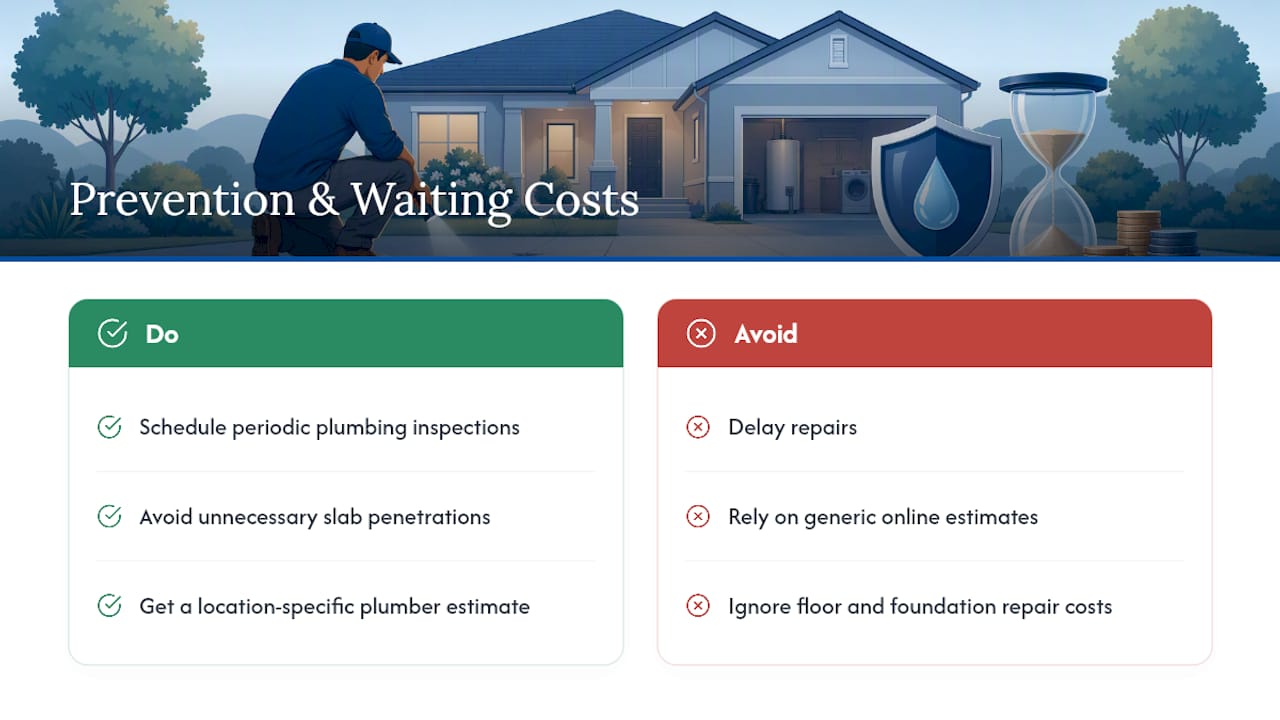
You can’t fully prevent a slab leak, but a few habits catch problems earlier. Homes with older copper-in-slab plumbing benefit from a periodic plumbing inspection, and avoiding unnecessary penetrations into the slab (extra anchors, new fixture lines) reduces the odds of accidentally nicking a pipe.
Repair cost depends heavily on your flooring. Cutting through carpet and concrete is far cheaper to restore than matching a discontinued tile pattern or refinishing hardwood. The size of the opening, whether a reroute or full repipe is needed instead of a spot fix, and local labor and permit costs all move the number. Ask a licensed plumber for a location-specific estimate rather than relying on a generic online figure, since slab work varies too much by house to price accurately from a distance.
What doesn’t vary is the risk of waiting. Left alone, a slab leak keeps eroding soil under your foundation, mold keeps spreading behind walls you can’t see, and continued pipe corrosion means you may end up paying for the same repair twice. In almost every case, the pipe itself is the cheap part. The floor, the foundation, and the mold remediation are where the real money goes if you let it run.
A Field Perspective on Getting the Diagnosis Right
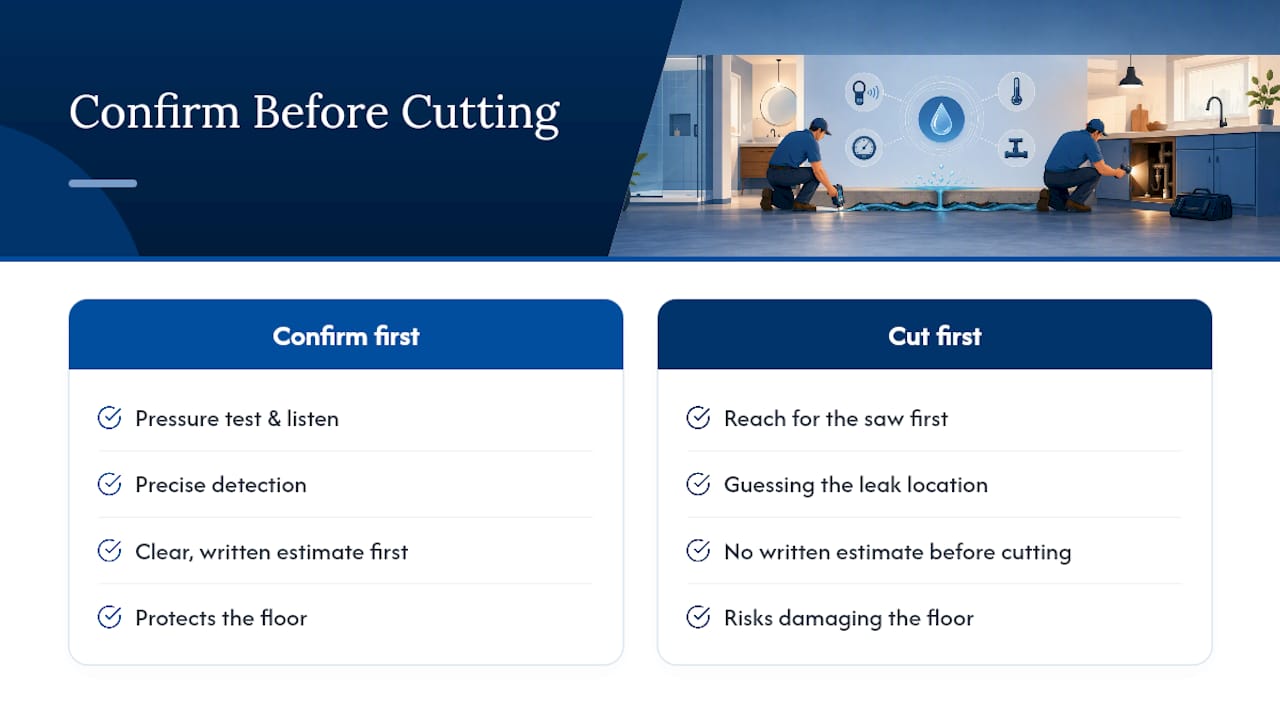
Our approach starts with confirming before cutting. A crew that reaches for a saw before running a pressure test or listening for the leak is guessing with your floor, and that guess can turn a $500 repair into a $5,000 one. Precise detection and a clear, written estimate before any concrete comes up is not optional, it’s the job.
[Author credentials and verified case studies for Dan Patino to be added.]
[Customer testimonials pending verification.]
— Dan Patino
Get a Straight Answer on Your Slab Leak
Texas Comfort Crew handles slab leak detection the way this article describes it should be done: confirm first, pinpoint precisely, cut only when necessary. Homeowners across the Greater San Antonio area call us specifically because we won’t recommend a full repipe when a spot repair will hold, and we won’t touch concrete without scanning for rebar and post-tension tendons first.

Our diagnostic process includes:
A water meter test and full property walkthrough to rule out false alarms
Acoustic listening and thermal imaging to narrow the leak location before any cutting
Tracer gas detection for plastic pipe or low-pressure leaks that acoustic tools miss
Rebar and tendon scanning before coring, plus a documented pressure test after the repair
If you’ve already run the meter test and confirmed continuous flow, don’t wait on a warm floor spot to turn into a cracked tile. Visit our plumbing services page or check our foundation plumbing page to schedule a diagnostic visit and get a written estimate before anyone touches your slab.
Sources
FAQ
Does Homeowners Insurance Cover a Slab Leak?
Most homeowners insurance policies cover the sudden damage a slab leak causes, like flooring or wall damage, but typically exclude the cost of the plumbing repair itself. Coverage details vary by policy, so check your specific plan and document the leak thoroughly before filing.
How Long Can a Slab Leak Go Undetected?
A slow slab leak can run for months or even longer before symptoms become obvious, especially a cold-side leak that doesn’t produce a warm floor spot. That’s exactly why catching early signs like a spinning water meter or a rising water bill matters more than waiting for visible damage.
Is a Slab Leak a Big Deal?
Yes. A slab leak that goes unaddressed can erode the soil under your foundation, cause structural cracking, and spread mold behind walls where you can’t see it. The pipe repair itself is rarely the expensive part; the foundation and mold damage from waiting usually cost far more.
Is a Slab Leak an Emergency?
It depends on what you’re seeing. Active flooding, a meter spinning fast, or sudden floor or wall movement call for immediate emergency service. A slow leak confirmed by a meter test but with no visible flooding can usually wait for a scheduled diagnostic visit within a day or two.
Recommended
Comments