
Repair vs. Replace HVAC: When Fixing Beats a New System
If your HVAC system is under 10 years old and the problem is a cheap part, fix it. If it’s past its expected lifespan or the repair bill is closing in on half the cost of a new unit, replacement wins on math and reliability. Two things override every calculation: safety and refrigerant.
A cracked heat exchanger, a gas leak, or any carbon monoxide risk means immediate replacement, full stop, regardless of the system’s age or how small the repair quote looks. A major compressor failure or a large refrigerant recharge on an aging unit almost always tips the scale toward a new system too, especially if that unit still runs on R-22.
Here’s the short version before you get into the numbers:
Repair when the system is under 10 years old, the failed part is inexpensive, and there’s no safety flag.
Replace when the system has reached its expected lifespan (10 to 15 years for AC and heat pumps, 15 to 20 for furnaces) or repairs approach a significant share of replacement cost.
Replace immediately, no exceptions, for cracked heat exchangers, gas leaks, or CO concerns.
TL;DR:
Repairs on systems under 10 years old and with inexpensive parts are typically worth pursuing, provided there are no safety concerns.
Replacement is advised once a system reaches its expected lifespan or when repairs cost close to half of a new unit’s price, especially on older units or those using R-22 refrigerant.
Safety issues like cracked heat exchangers, gas leaks, or carbon monoxide risks require immediate replacement regardless of repair estimates or age.
The $5,000 rule (age in years times repair cost) helps gauge whether repair or replacement is better, but refrigerant type and safety flags override this calculation.
Homeowners should gather specific data, including age, repair scope, refrigerant type, and safety status, before making a repair vs. replace decision.
Table of Contents
What Facts You Need Before Deciding Repair vs. Replace HVAC
You can’t run any repair vs. replace HVAC comparison without real numbers in hand. Guessing at your system’s age or eyeballing a repair estimate leads to bad decisions in both directions, either paying for a fifth repair on a dying unit or replacing a system that had years left in it.
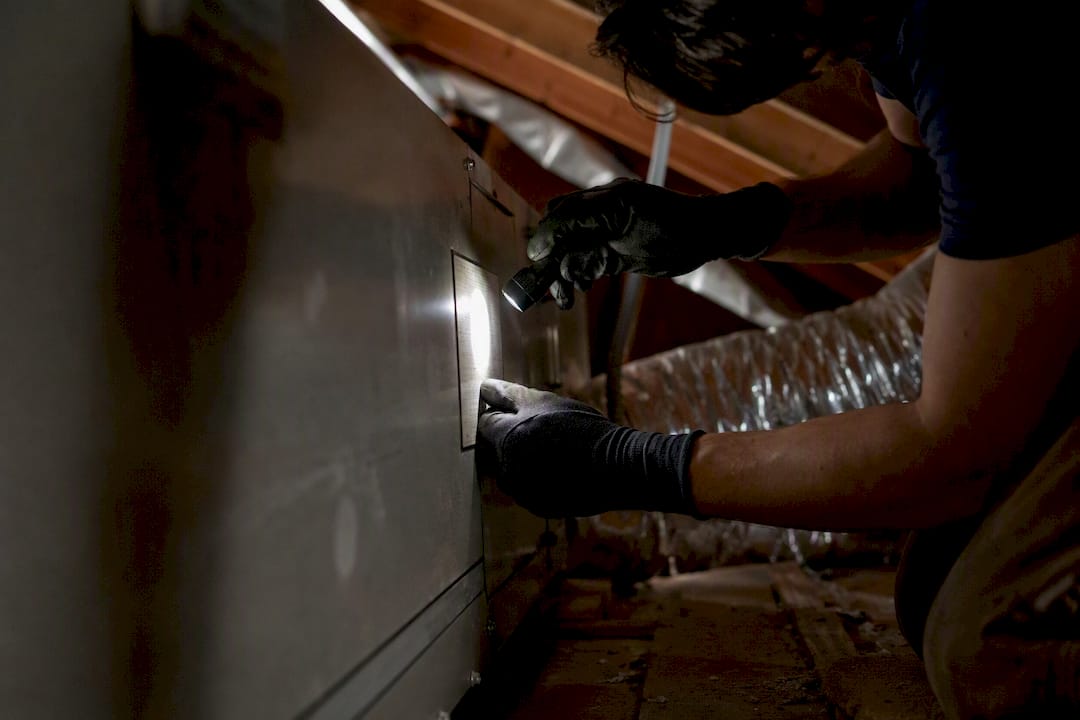
Start by finding the manufacture date. It’s stamped on a metal nameplate inside the unit’s access panel, usually as a serial number with an embedded date code, not the year you moved in or the year it was “installed” according to family memory. Once you have that, here’s what to gather next:
Confirm the age against expected lifespan. Central air conditioners and heat pumps typically run 10 to 15 years; furnaces last 15 to 20.
Get a full repair quote in writing, broken into parts, labor, and the technician’s honest estimate of how many more years that fix buys you.
Get a replacement quote that lists SEER2 or AFUE rating, warranty terms, and exact scope (is ductwork included? Electrical upgrades?).
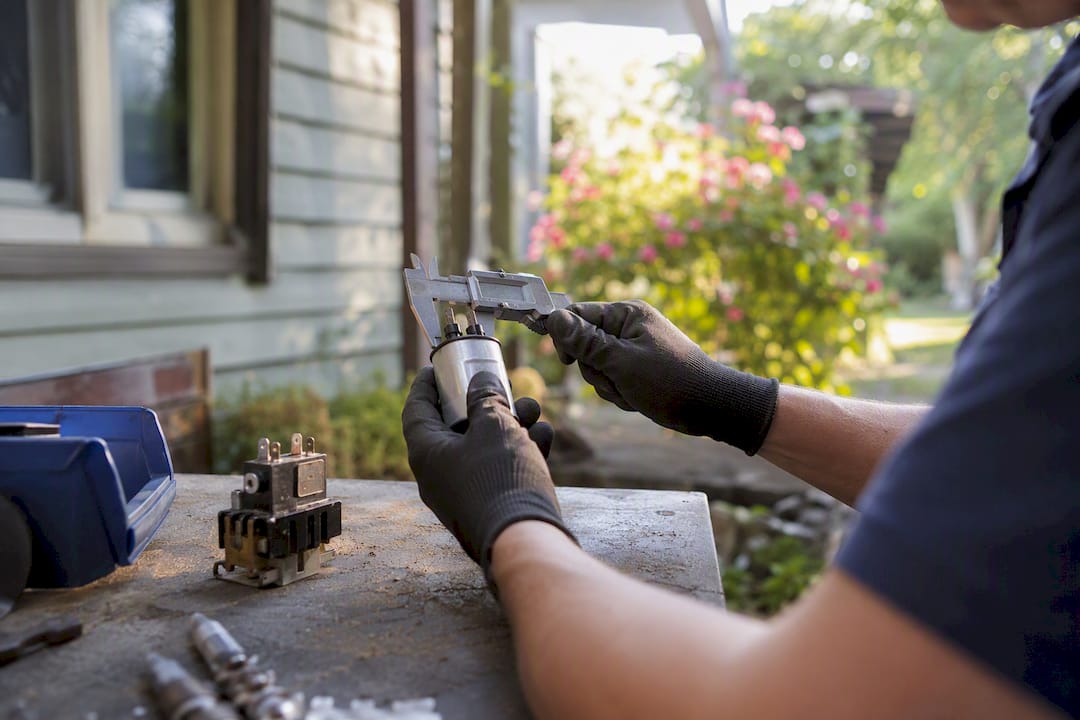
Ask specifically what failed. A capacitor is a $150 fix. A compressor is a different conversation entirely.
Ask how much refrigerant the repair requires, in pounds, and whether the unit uses R-22 or R-410A.
Pull your maintenance and repair history. Three service calls in two years tells a different story than a first-time failure.
Get at least two independent quotes before committing to either path. A technician paid to sell replacements and one paid to prioritize repairs will often land on very different recommendations for the identical unit.
Pro Tip: Take a photo of the nameplate with your phone the next time a technician is in your attic or utility closet. You’ll have the exact model and serial number ready the moment you need a second opinion.
How Do the $5,000 Rule and the 50% Rule Work?
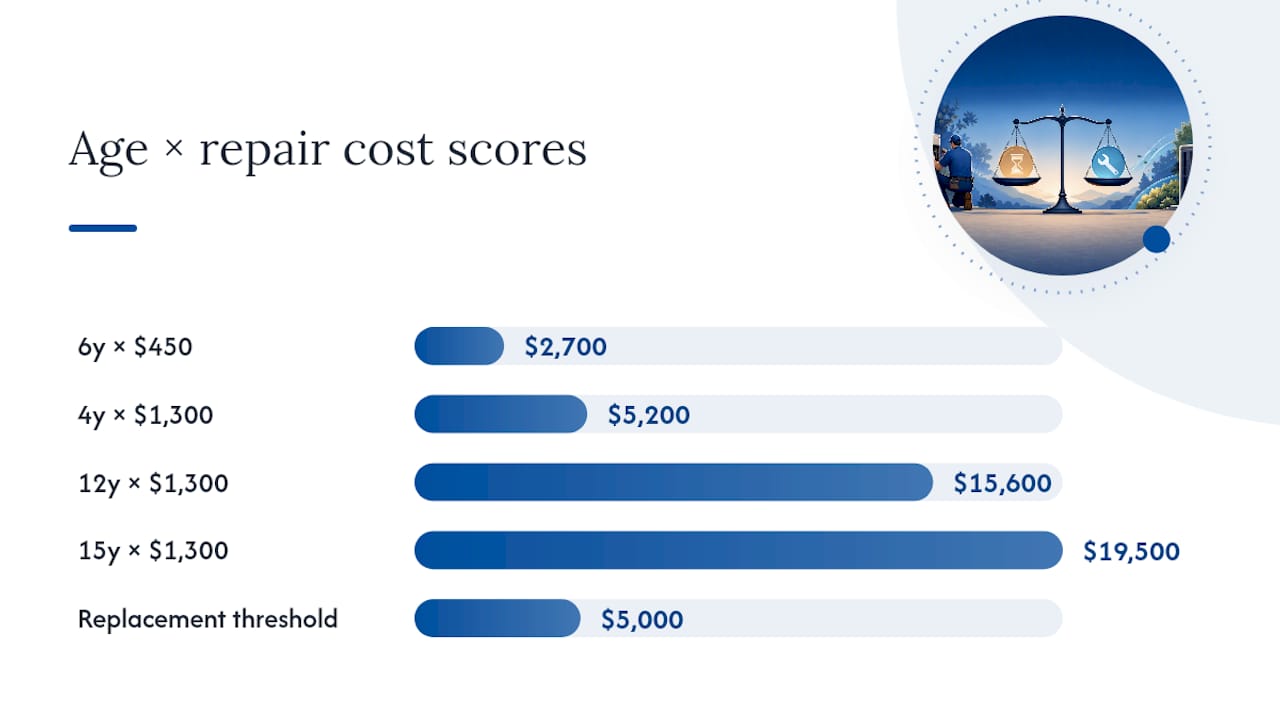
The the $5,000 rule is the fastest triage tool in HVAC: multiply the system’s age in years by the estimated repair cost. If the result tops $5,000, lean toward replacement. A repair cost on a 12-year-old unit that exceeds the threshold and points toward a new system. A minor repair on a 4-year-old unit stays well under it.
The rule is useful, but treat it as a starting filter rather than the final word. It doesn’t know whether your repair involves a $40 part or a refrigerant type that’s getting harder to source every year, and contractors themselves flag it as imperfect for exactly that reason.
That’s where the percent-of-replacement rules come in. The 50% rule says: if a single repair costs a large portion of a full replacement, replace. The 30% version is a softer sanity check, worth pausing on if repairs hit even 30% of replacement cost, especially on a system already past 10 years old.
Here’s how that plays out in practice:
A $450 capacitor and blower repair on a 6-year-old AC: age × cost = 2,700, nowhere near the threshold, and well under 30% of a typical replacement. Repair.
A $1,300 refrigerant leak repair on a 12-year-old AC: age × cost = 15,600, refrigerant is likely R-22 or aging R-410A, and the repair may be 25 to 30% of replacement cost. Replace.
The system’s age drives the $5,000 math far more than most homeowners expect. That same $1,300 repair on a 4-year-old unit produces a score of just 5,200, barely over the line, while identical costs on a 15-year-old unit multiply the signal toward replacement almost automatically.
None of this applies once safety enters the picture. A cracked heat exchanger or CO risk overrides every dollar figure on the table.
Does Regular Maintenance Change the Repair or Replace Decision?
Maintenance doesn’t just extend a system’s life; it often decides which side of the repair vs. replace HVAC line you land on in the first place. A neglected unit fails earlier and harder, usually at the worst possible time, like the first 100 degree week of a Texas summer, when San Antonio’s heat and humidity affect interior doors and HVAC performance.
ENERGY STAR’s maintenance checklist covers the basics that prevent most premature failures:
Replace or clean filters on a regular schedule, not just when airflow noticeably drops.
Clean condenser and evaporator coils, since dirty coils force the compressor to work harder and fail sooner.
Check electrical connections and refrigerant charge during seasonal visits.
Schedule a cooling tune-up each spring and a heating tune-up each fall.
A typical pre-season maintenance visit runs roughly $100 to $350 depending on region and scope; be wary of anything advertised well under $70, since that usually means a rushed filter swap, not a real inspection. When replacement does make sense, the efficiency gain is real: ENERGY STAR estimates up to 20% annual savings on cooling costs from a modern AC or heat pump, and about 15% for a high-efficiency furnace over an older model.
Which Repairs Are Almost Always Worth Fixing?
Most HVAC service calls involve parts that are cheap to replace and don’t signal a dying system. These repairs are routine maintenance, not a warning sign:
Failed capacitor or contactor (the electrical components most likely to wear out first)
Blower motor replacement
Igniter or flame sensor on a furnace
Thermostat or control board issues
Minor refrigerant top-offs on systems still under 8 to 10 years old
A repair like this is a reasonable stopgap even on a slightly older system, buying you one to three more years of service if the rest of the unit tested clean. Warranty coverage matters here too: if the compressor or coil is still under a manufacturer warranty, a repair often costs only labor, which changes the math entirely compared to paying full price out of pocket.
Pro Tip: Ask your technician to flag anything else they notice while they’re in there, even if it’s not failing yet. A capacitor going bad at year 8 is often a preview of a contactor problem at year 9.
When Should You Replace Instead of Repair?
Some findings during a service call make replacement the clear answer, no rule-of-thumb calculation required.
A cracked heat exchanger, a detected gas leak, or any carbon monoxide reading means immediate replacement.
A failed compressor on a unit already past 10 to 12 years old rarely justifies the repair cost relative to remaining life.
A large refrigerant recharge, particularly on systems still running R-22, tends to be poor value, since that refrigerant is being phased out and costs far more than R-410A.
Two or more major repairs within 12 to 18 months on the same unit.
If a single repair quote lands at 30 to 50% of a full replacement estimate and the unit is already at or past its expected service life, replacement is almost always the stronger long-term value, even when the upfront number feels larger.
What Does HVAC Replacement Actually Cost?
Replacement cost varies widely by system size, efficiency tier, and ductwork condition, so treat any number as a planning range rather than a quote. Minor repairs like a capacitor or contactor typically run a few hundred dollars; major repairs involving a compressor or a full refrigerant recharge can run well into four figures, sometimes close to replacement cost itself once labor and refrigerant pricing are factored in.
To compare lifetime cost fairly, weigh three things together: how many years of service the current unit likely has left, how often it has needed major repairs recently, and what a new system saves annually on energy. A few practical ways to make replacement more affordable:
Ask about installment or promotional financing plans, which spread the upfront cost over months rather than requiring a lump sum.
Consider a maintenance membership, which often includes discounted repair rates and priority scheduling.
Schedule replacement in shoulder seasons (spring or fall) rather than mid-July, when demand and pricing both peak.
How Texas Comfort Crew Approaches the Repair or Replace Question
Texas Comfort Crew was built around a simple frustration homeowners across the Greater San Antonio area kept running into: getting pushed toward a full replacement when a repair would have solved the problem just fine. The team’s evaluations walk through the same age, cost, and safety factors covered above, out loud, before making a recommendation.
Every diagnostic includes a plain-language explanation of what failed and why.
Repair is presented first whenever it’s the sound long-term choice, not the upsell.
Replacement gets recommended only when age, safety, or refrigerant economics genuinely call for it.
A technician who explains the the $5,000 rule and the 30% threshold on your own numbers, in your driveway, before recommending anything, is doing the job the way it should be done.
The goal is a homeowner who understands the recommendation well enough to have made it themselves.
What This Repair vs. Replace HVAC Playbook Gets Right
Most advice on this topic treats the the $5,000 rule like gospel, and that’s the first mistake. It’s a triage filter, not a verdict. The rule was never built to know your refrigerant type or whether your compressor still carries a warranty, and treating it as final produces exactly the kind of unnecessary replacements homeowners are rightly suspicious of.
The bigger blind spot in conventional advice is refrigerant economics. Most homeowner guides mention age and repair cost and stop there, when the real inflection point on older systems is often refrigerant availability, not the compressor itself. A 12-year-old unit with a straightforward electrical failure is a repair. The same unit needing a refrigerant recharge on legacy R-22 is a different conversation entirely, and the math alone won’t tell you that.
If I had to boil this down to one instruction: get the actual numbers, in writing, before you decide anything. Age times repair cost. Percent of replacement. Refrigerant type. Any safety flag. Homeowners who ask for those specifics, rather than accepting a verbal recommendation, consistently end up with the decision that actually fits their system.
— Dan Patino
Get a Straight Answer From a Repair-First HVAC Team
Running the the $5,000 rule and the 30% threshold on your own quotes only gets you so far without someone who can verify the compressor condition, refrigerant type, and safety status in person. Texas Comfort Crew sends technicians who walk through that exact math with you, on-site, and recommend repair whenever the numbers and the safety check support it, rather than defaulting to a sale.

That approach matters most for homeowners who’ve been burned before by a quote that jumped straight to “you need a new system” without ever pricing out the repair. If you’re in Spring Branch, New Braunfels, Helotes, or anywhere else across the Greater San Antonio service area, book a diagnostic visit in Spring Branch or check coverage across the wider service area to get a repair quote and a replacement quote side by side, in writing, before you decide anything. Homeowners who want to head off major repairs altogether can also look into a maintenance membership for priority scheduling and discounted service calls year round.
Key Takeaways
Repair usually wins under 10 years old with a minor failure, while replacement wins at end of life, at 30 to 50% of replacement cost, or whenever safety or refrigerant economics are involved.
Point | Details |
Know your system’s age | Check the nameplate serial number, not move-in date, against 10 to 15 years for AC/heat pumps and 15 to 20 for furnaces. |
Apply both rules together | Use the the $5,000 rule (age times repair cost) as a filter, then sanity-check against the 30 to 50% replacement-cost threshold. |
Safety always overrides math | A cracked heat exchanger, gas leak, or CO reading means immediate replacement regardless of cost calculations. |
Refrigerant type matters | Large recharges or legacy R-22 systems tilt heavily toward replacement due to rising refrigerant costs. |
Get repair-first evaluations | Texas Comfort Crew walks homeowners through the age, cost, and safety math before recommending repair or replacement. |
Sources
FAQ
Should I Repair or Replace My HVAC Unit?
Repair if the system is under 10 years old with a minor, inexpensive failure and no safety flags.
What Is the $5,000 Rule for HVAC?
Multiply the system’s age in years by the repair cost estimate. If the total exceeds $5,000, replacement is usually the better financial choice, though refrigerant type and safety findings can override that math.
Is Replacing an AC Unit a Repair or an Improvement?
A full AC replacement counts as a capital improvement rather than a repair, since it replaces the entire system instead of fixing a specific failed part.
Is It Better to Repair an AC or Buy a New One?
It depends on age, repair cost relative to replacement, and safety status. A technician who reviews your specific quotes, similar to how Texas Comfort Crew approaches every evaluation, can tell you which side of that line your system falls on.
Recommended
Comments