
Homeowners: Fix a Hot Room Tonight, 3 Checks and What Pros Measure
The room isn’t cooling because it’s either not getting enough conditioned air or it’s absorbing heat faster than your system can remove it, and it’s usually one specific problem, not a mystery. Start with three checks tonight: swap the air filter, confirm every vent in that room is open and unblocked, and switch the thermostat fan to “on” for ten minutes to see if airflow improves. If none of that helps, the cause is likely hiding in your ductwork, insulation, or equipment.
TL;DR:
Duct leaks, long duct runs, or disconnected dampers are the main causes of uneven cooling in a room, particularly when it is farthest from the air handler.
Closing vents in unused rooms increases static pressure, worsens duct leaks, and strains the blower, making the problem worse rather than better.
Testing airflow with a tissue near vents and monitoring how the temperature changes with the door open can help identify airflow or pressure issues before calling a technician.
A professional air balancing service measures cubic feet per minute at each register and adjusts dampers to restore proper airflow within 90 to 110 percent of the system’s design CFM.
Troubleshooting should start with simple checks on filters, vents, thermostat placement, and visible duct damage before proceeding with repair or replacement options.
Table of Contents
What’s Behind One Room Not Cooling: Quick Checks First
Before you start tearing into ductwork or calling a technician, run through the basics. Most uneven cooling in house situations trace back to something simple you can fix in the next thirty minutes, and even when they don’t fix it, these checks give a technician a head start.
Check the air filter. A clogged filter chokes airflow to the whole system, but rooms farthest from the unit feel it first. If it’s gray, matted, or hasn’t been changed in more than 90 days, swap it before doing anything else.
Inspect every vent in the room. Open supply registers fully, then check the return vent too. Furniture, rugs, curtains, and closed doors block more airflow than people realize.
Test the thermostat fan setting. Switch it from “auto” to “on” for ten minutes. This runs the blower continuously and can reveal whether the room warms up because of poor circulation rather than a cooling problem.
Confirm the thermostat’s mode and location. If it sits in a hallway or near a kitchen, it may be reading a temperature that doesn’t match the problem room at all.
Look at the outdoor condenser. Confirm it has power, isn’t caked in debris or grass clippings, and that the fan blade spins freely when the system runs.
A simple paper or tissue test tells you a lot. Hold a strip of tissue paper near the supply vent in the affected room and compare how strongly it flutters against a vent in a room that cools fine. Weak or no movement points toward a duct or blockage issue rather than a thermostat problem.
Keep a short log as you go: room name, vent location, and airflow strength (high, medium, or low). That single sheet of paper saves a technician time and often saves you money, since it narrows the diagnostic search before anyone opens a wall or crawls into the attic.
Pro Tip: Do the fan-on test at the same time of day you notice the room getting hot. Heat gain from sun exposure changes by the hour, and testing at 2 p.m. versus 8 a.m. can give you two completely different readings.
For a broader rundown on related symptoms, our AC not cooling troubleshooting guide covers system-wide issues that sometimes masquerade as a single-room problem.
Why Airflow and Duct Problems Leave One Room Warm
If the quick checks didn’t solve it, the next suspect is the duct system feeding that room. Ducts are the plumbing of your AC system, and like plumbing, they leak, narrow, and lose pressure over distance.
The average home loses 20% to 30% of the air moving through its duct system to leaks and poor sealing, according to ENERGY STAR. That air doesn’t disappear. It escapes into attics, crawlspaces, and wall cavities before it ever reaches a register, and the rooms at the far end of a duct run feel that loss the most. If your problem room happens to be the farthest from the air handler, or the last stop on a long duct branch, this is often the entire explanation.
A few structural issues compound the problem:
Long or undersized duct runs lose static pressure the farther air travels, so the last register in line gets a fraction of the airflow the first one does.
Crushed or kinked flexible ductwork in an attic or crawlspace can cut airflow by half even when the duct itself isn’t leaking.
Disconnected duct collars at the register boot let conditioned air dump into the attic instead of the room.
Closed or stuck dampers somewhere upstream can starve one branch while flooding another.
Return-air restrictions, like a closed door with no return path, create pressure imbalances that push air away from that room instead of into it.
Here’s where a lot of well-meaning homeowners make things worse: closing vents in rooms you don’t use to “push more air” toward the problem room. That doesn’t work the way people think. Closing registers raises static pressure throughout the whole duct system, which can strain the blower motor, worsen existing duct leaks, and shorten equipment life over time. HVAC systems are designed around a specific airflow balance, and manually choking vents fights against that design instead of fixing it.
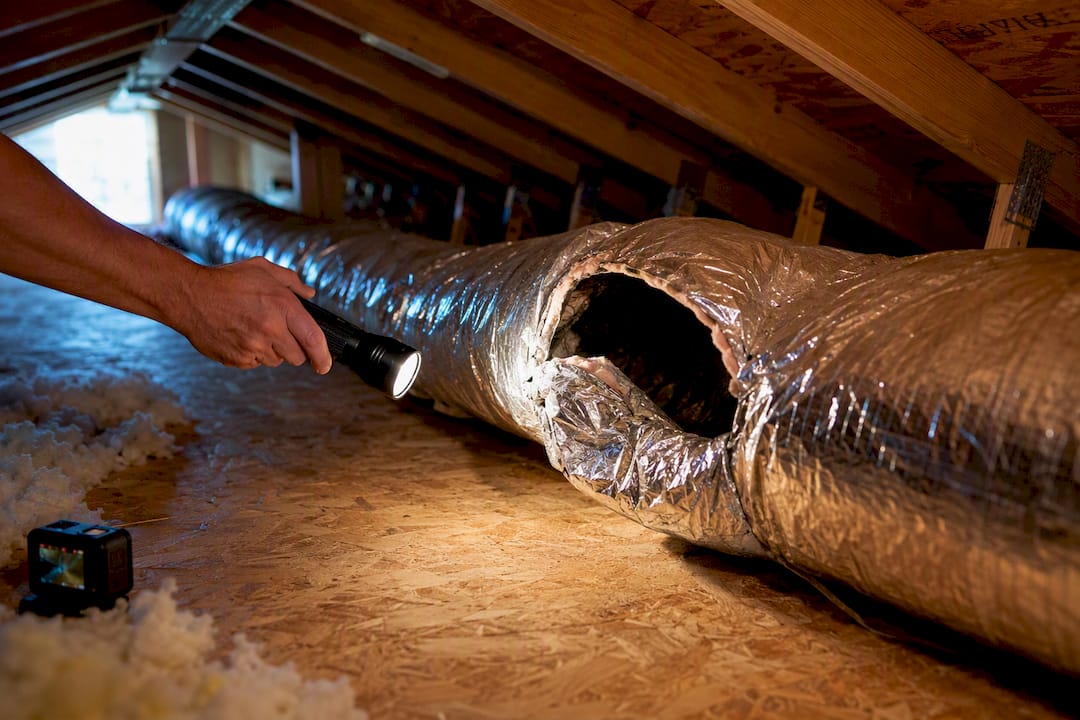
If you have attic or crawlspace access, take a flashlight up there and look for visible signs of trouble: disconnected duct joints, ductwork resting on insulation instead of hung properly, or flex duct that’s been stepped on and flattened. You don’t need to fix any of it yourself, but photographing what you find gives a technician a massive head start and helps you avoid paying for a full diagnostic just to find what you could see in five minutes.
How to Test Airflow Yourself and What a Pro Measures
DIY diagnostics only take you so far, but they’re worth doing before you spend money on a service call. Here’s the sequence that actually produces useful information.
Run the fan-on test room by room. Set the thermostat fan to “on,” then walk through the house feeling airflow at each supply vent. Note which rooms feel strong and which feel weak or still.
Do the paper test at the weak vents. Hold a tissue near the register. If it barely moves compared to other rooms, you’ve confirmed a real airflow deficit, not just a perception problem.
Test the room with the door open versus closed. If the room cools noticeably better with the door open, you likely have a return-air or pressure imbalance rather than a straight duct blockage.
Check any accessible dampers. Some duct systems have manual dampers near the plenum. A small adjustment can sometimes help, but treat this as a temporary patch, not a fix.
Write down everything. Weak vents, door-open results, odd noises, or ice on the refrigerant lines outside all matter to a technician.
Air balancing isn’t guesswork. Professionals use a flow hood to capture the actual cubic feet per minute (CFM) moving through each register, then compare it against the system’s design target. A balanced system typically reads within 90% to 110% of that design CFM at every outlet, not just the ones closest to the air handler.
Two professional balancing approaches exist. Proportional balancing sets each outlet’s flow relative to the others using a fixed ratio, while predictive balancing uses calculated adjustments and modeling tools to hit target CFM faster with fewer trial-and-error passes. Either way, a technician is adjusting dampers and sometimes blower speed based on real measurements, not by feel.
Pro Tip: If closing a vent seems to help temporarily, don’t treat that as a permanent solution. Log which vent and by how much, then mention it to your technician. It’s diagnostic information, not a fix.
Stop the DIY approach the moment you notice ice forming on the outdoor unit’s refrigerant lines, a burning smell from the blower, or airflow that’s weak at every vent in the house, not just one room. Those point to equipment problems that need a licensed technician.
Other Causes: Thermostat Placement, Insulation, and Equipment Faults
Not every uneven cooling in house complaint comes from ductwork. Several other culprits show up often enough to check before assuming the worst.
Thermostat placement. A thermostat near a kitchen, sunny window, or hallway vent reads a skewed temperature, and the system stops cooling before the problem room actually reaches the setpoint. A zoned system or a smart sensor placed in the affected room often solves this without any duct work at all.
Attic heat gain. On a 105°F day, an uninsulated or under-insulated attic can reach between 150°F and 160°F, and that heat radiates straight down into the ceiling of any room beneath it. If your hot room sits under a low-insulation section of attic, no amount of duct sealing fixes that alone.
Solar exposure through windows. West-facing rooms with large windows and no coverings can gain more heat than a duct run ever loses. Blackout curtains, solar film, or even temporary reflective shades cut that load noticeably.
Equipment faults. A weak blower motor, low refrigerant charge, or a dirty evaporator coil reduces total system capacity. These usually show up as house-wide weak cooling, not just one room, but in smaller homes or single-zone systems, one room can bear the brunt first.
When to Call an HVAC Pro and What Happens Next
Call a technician if airflow stays weak after your own checks, if you spot ice on the refrigerant lines, or if the temperature gap between rooms persists no matter what you adjust.
A proper diagnostic typically includes:
Static pressure readings at the air handler
A duct leakage test
Flow hood measurements at each register (CFM)
Refrigerant charge verification
Damper and zone evaluation where applicable
Expect a diagnostic fee for the visit, then a separate quote for repairs like duct sealing, per-opening balancing, damper adjustment, or refrigerant service, depending on what the technician finds. Bring your notes. A technician who sees “weak at bedroom vent, improves with door open, no ice on lines” can skip straight to testing the return path instead of starting from zero.
The Inspection-First Approach to Fixing a Hot Room
Texas Comfort Crew treats a hot room as a diagnostic puzzle, not an automatic replacement sale. The workflow starts with the same checks covered here: filters, vents, thermostat placement, then a visible duct inspection in the attic or crawlspace before recommending anything. Sealing a leaky run or adding a damper often solves the problem for less than a full system overhaul, and homeowners deserve to know that option exists before signing off on bigger work.
— Dan Patino
Get a Diagnostic That Actually Finds the Problem
A professional HVAC and plumbing service provider is the alternative to guessing your way through vent adjustments and thermostat swaps. Instead of jumping straight to a system replacement quote, the team runs the same airflow and duct checks covered in this article, then explains exactly what they find and what it costs to fix before any work starts.

That means if the fix is a sealed duct joint or a rebalanced register instead of a new unit, you’ll hear that option first. Homeowners in Boerne, Stone Oak, Live Oak, and surrounding communities can schedule a diagnostic visit and get a straight answer about why one room won’t cool, backed by actual measurements instead of a sales pitch.
Sources
The duct leakage figures throughout this article come from ENERGY STAR’s duct sealing guidance. Attic temperature and insulation data draw from Energy.gov’s attic insulation resource. Professional balancing methods, including flow hood testing and CFM targets, are detailed at This Old House and Dwyer’s air balancing overview.
FAQ
Why does my AC cool one room but not another?
The most common cause is duct-related. Long duct runs, leaks, or undersized branches reduce airflow at the farthest registers, while attic heat gain or poor insulation can also overwhelm a specific room regardless of duct condition.
How do I fix a room that’s colder or hotter than the rest of the house?
Start with the filter, vents, and thermostat fan setting, then check for attic insulation gaps or sun exposure through windows; if none of that resolves it, a professional air balancing service measures CFM at each register and adjusts dampers to bring airflow within the target range.
How do I fix one room that stays hot no matter what?
Rule out blocked vents and a dirty filter first, then check whether the room sits under a hot, under-insulated attic section or has heavy west-facing sun exposure, both of which can overwhelm a healthy AC system.
Why is my air conditioner blowing air in some rooms but not others?
This usually points to a duct leak, a crushed or disconnected duct run, or a closed damper somewhere upstream of the weak register, and a technician can confirm the exact location using a flow hood and static pressure readings.
Is it bad to close vents in unused rooms to help a hot room cool faster?
Yes. Closing vents raises static pressure throughout the duct system, which can strain the blower motor and worsen existing leaks rather than solving the airflow problem in the room you’re trying to cool.
Recommended
Comments