
Main Sewer Line Clog: Signs, Causes, and Fast Fixes
If more than one drain in your house is backing up at the same time, your toilet gurgles when the washing machine drains, or you see sewage bubbling up from a floor drain or outdoor cleanout, you almost certainly have a main sewer line clog. This is different from a single slow sink or a clogged toilet trap. When the blockage sits in the main line, everything downstream of it, every fixture in the house, feels it at once.
The first move matters more than people think: stop using water immediately. Don’t run the dishwasher, don’t do laundry, don’t flush again “just to check.” Every gallon you send down the drain has nowhere to go but back up, and in a main line clog, that often means into your lowest fixtures, your basement floor drain, or your yard.
Here’s your immediate checklist for the first ten minutes:
Stop all water use in the house, including the washing machine and dishwasher.
Locate your sewer cleanout (usually a capped pipe near the foundation or in the yard) but do not remove the cap if you suspect a full backup, since pressure can force sewage out forcefully.
Check whether multiple fixtures are affected, not just one, to confirm it’s a main line issue rather than a single clogged drain.
Avoid plunging a toilet aggressively during a suspected main line clog, since it can push waste further into the line or force it into other fixtures.
Keep kids and pets away from any standing water near cleanouts or floor drains.
Pro Tip: If sewage is visible anywhere in the house, from a shower drain, a basement floor drain, or a toilet base, treat it as a public health issue and stop all water use. Professionals recommend prioritizing water shutoff first before attempting anything else, because contaminated water spreading through your home is a bigger problem than the clog itself.
Key Takeaways
A main sewer line clog almost always announces itself through multiple simultaneous drain problems, and stopping water use immediately while locating the cleanout is the correct first response every time.
Point | Details |
Identify true emergency signs | Multiple drains backing up together, gurgling toilets, or sewage at a cleanout mean the main line, not a single fixture, is blocked. |
Stop water and locate the cleanout | Shut off all water use and find the cleanout cap, but don’t open it if pressure or sewage is visible. |
Understand recurring clogs | Repeat blockages, especially root related ones, usually signal a crack or joint gap that needs repair, not just clearing. |
Call for camera scoping when signs multiply | A licensed plumber’s video inspection settles whether you need clearing or structural repair like trenchless lining. |
Texas Comfort Crew’s approach | Texas Comfort Crew scopes the line before recommending repairs, offering clearing, hydro-jetting, and trenchless options across Greater San Antonio. |
Table of Contents
Warning Signs of a Main Sewer Line Clog and How to Confirm Them
A single slow drain rarely means a main line problem. What separates a garden-variety clog from a full main sewer line clog is that the symptoms show up in places that shouldn’t be connected to each other.
Here’s what to look for and what each sign actually tells you:
Multiple drains backing up at once. If your kitchen sink gurgles when you flush the toilet, or your shower drain fills with water when the washer empties, that’s the clearest sign of all. Fixtures on a shared line only interact with each other when something downstream of all of them is blocked.
Gurgling toilets or drains. That sound is trapped air escaping past a blockage. It happens when water tries to push through a partially clogged main line and air gets forced backward through the plumbing vents.
Water backing into the tub or shower when you flush the toilet. This is one of the most reliable signs of main sewer line clog symptoms. Toilets sit lower in the drainage system than tubs in many homes, so when the main line can’t handle the flow, water finds the next lowest point.
Sewage surfacing from a cleanout or floor drain. This is not a “wait and see” sign. If you see wastewater pooling at an outdoor cleanout or coming up through a basement floor drain, the line is fully or nearly fully blocked.
A persistent sewer smell indoors or in the yard. Sometimes the backup hasn’t reached fixtures yet, but gas escaping from a cracked line or an overwhelmed drain trap will announce itself before water does.
To confirm what you’re dealing with, run a simple flush test: flush the toilet and watch the tub, shower, and any floor drains for a minute or two. If water rises anywhere other than the toilet, you’re looking at a main line issue, not an isolated clog. Then walk through the house and run water briefly in a few other fixtures, a sink, a shower, to see if the problem is isolated or system-wide.
If you find sewage actively surfacing at a cleanout, in a tub, or on a floor, that’s not a DIY moment. Stop, shut off water use, and call a licensed plumber. Anything short of active sewage exposure gives you a little more room to investigate further before making that call.
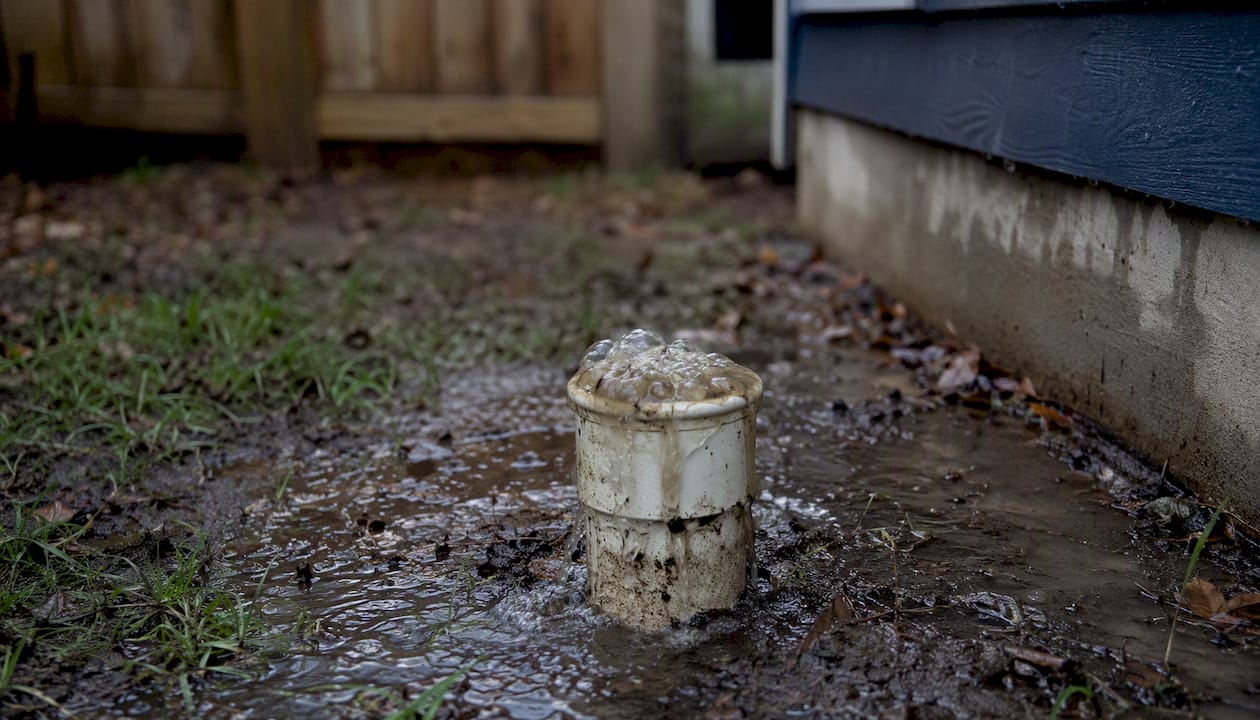
What Causes a Main Sewer Line Clog
Most main sewer line clogs trace back to a handful of repeat offenders, and knowing which one you’re dealing with tells you a lot about whether a quick clear will hold or whether you’re looking at a bigger repair down the road.
Tree root intrusion. Roots seek out moisture, and a sewer line carrying wastewater is basically an underground water source with a leak already built in.
FOG buildup (fats, oils, and grease). Poured down a kitchen drain while hot, grease cools and solidifies inside the pipe, narrowing the passage over months until it catches debris and closes off flow entirely.
Non-flushable items. Wipes labeled “flushable,” paper towels, and feminine hygiene products don’t break down the way toilet paper does, and they’re one of the most common causes of blockages in modern sewer lines.
Pipe bellies, offsets, and collapses. A belly is a low spot in the pipe where the ground has settled, and it holds standing water and solids even when nothing else is wrong. An offset happens when pipe segments shift out of alignment at a joint.
Aging pipe materials. Clay and cast iron sewer lines, common in homes built before the 1970s, degrade over decades, developing cracks and joint separations that invite exactly the problems above.
Tree roots deserve a closer look because they’re widely misunderstood. Roots are reported to cause more than 50% of sewer blockages in older systems, which sounds like the root is the villain. It’s more accurate to say the root is a symptom. Roots can’t punch through solid, intact pipe. They exploit cracks or loose joints that already exist, then widen those gaps as they grow thicker, turning a hairline leak into a structural failure over a few years.
That distinction changes how you should think about “fixing” a root problem. Cutting the roots out clears the flow, but if the crack that let them in is still there, new roots will find it again, often within a year or two. That’s why a clog that comes back every six to twelve months, especially near a specific spot in the yard, usually signals a structural issue rather than a one-time blockage.
How to Diagnose a Main Sewer Line Problem
Before calling anyone, there’s a useful sequence of checks you can run yourself, safely, that will either resolve your uncertainty or give a plumber a head start when they arrive.
Start with these steps:
Stop all water use in the house the moment you suspect a main line problem.
Check every fixture, not just the one that’s acting up, to see how widespread the backup is.
Locate your sewer cleanout, typically a white or black capped pipe near your foundation, in the yard, or in a utility area.
Look at the ground around any outdoor cleanout for standing water or a sewage odor before touching the cap.
If the cap looks pressurized (water bulging at the seal) or sewage is already visible, don’t open it. Call a professional instead.
Once a plumber is on-site, the tool that actually settles the question is a video camera, often called sewer scoping. A flexible camera on a cable runs through the line and shows exactly what’s happening inside the pipe: root masses, cracks, bellies, offset joints, or a straightforward clog of grease and debris. Camera inspection is the standard method professionals use to decide whether a job needs simple cleaning or full structural repair, because guessing at what’s inside a buried pipe from surface symptoms alone is unreliable.
Pro Tip: Ask whoever does your camera inspection to record the footage and mark the distance from the cleanout to any defect they find. That footage becomes useful documentation if you need a second opinion or if you’re negotiating repair costs later.
Certain findings during diagnosis are red flags that should stop any DIY plans immediately: a collapsed section of pipe, a belly holding standing water on camera, root masses so dense they’ve deformed the pipe wall, or sewage actively backing up under pressure at the cleanout. Any of those means you’re past the point where a homeowner should be experimenting.
How to Clear a Main Sewer Line
There’s a real difference between what a homeowner can safely attempt and what actually requires professional equipment, and conflating the two is how people make a clog worse.
Safe DIY steps you can try first:
Shut off water use throughout the house before attempting anything.
Locate the cleanout and, if there’s no visible pressure or sewage present, cautiously remove the cap to relieve any buildup and see if water starts draining on its own.
Skip caustic chemical drain cleaners for a suspected main line clog. If the pipe has an existing crack or joint separation, and you don’t know whether it does, harsh chemicals can sit in that section and do more harm than good, plus they’re a hazard if you end up needing a plumber to open the line manually afterward.
A basic drain snake reaches maybe 25 feet, nowhere close to where most main line clogs actually sit, so treat a manual snake as a diagnostic step at best, not a fix.
When DIY fails, here’s what a licensed plumber brings to the job:
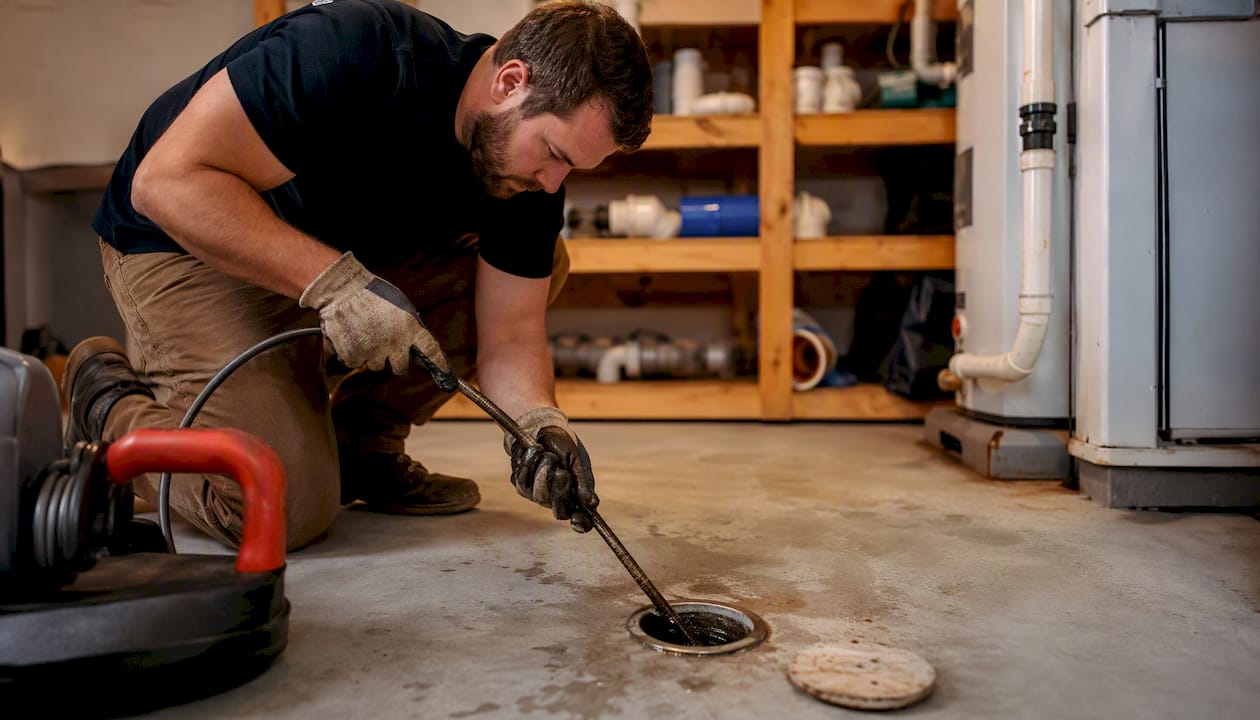
Mechanical snaking with root cutters uses a motorized cable with a cutting head that can chew through root masses and break up solid blockages along the entire run of pipe, not just the first few feet. Hydro-jetting takes it further, blasting high-pressure water through the line to scour the pipe walls clean of grease, scale, and root fragments that a cutter head leaves behind. Chemical root treatments have a place, but they work best as a maintenance step after mechanical clearing, not as a way to open a fully blocked line on their own.
Method | Best for | Drawbacks |
Manual drain snake (DIY) | Minor clogs close to the cleanout | Limited reach, won’t touch deep blockages or root masses |
Mechanical root cutter | Root intrusion, solid debris blockages | Requires professional equipment; doesn’t fix underlying cracks |
Hydro-jetting | Grease buildup, scale, general debris clearing | Can be too aggressive for old or already-fragile pipe without prior camera check |
Chemical root treatment | Preventive maintenance after clearing | Ineffective alone on a fully blocked line; some products are corrosive |
Pro Tip: If a plumber suggests hydro-jetting, ask whether they scoped the line first. Jetting a pipe with an unknown belly or a badly cracked section can occasionally push debris into a low spot instead of flushing it out, so a quick camera check beforehand avoids wasted effort.
What It Costs and How Long It Takes to Clear or Repair a Main Line
Money and time both hinge on one question: are you clearing a clog, or fixing a broken pipe? Those are two very different jobs with very different price tags.
A straightforward clog, grease buildup or a manageable root mass, cleared by mechanical snaking or hydro-jetting, is usually a same-day job. A technician arrives, diagnoses with a camera if needed, clears the line, and confirms flow before leaving. Diagnosis itself, especially a full camera scope, typically takes under an hour.
Repairs are a different story. A spot repair to fix one cracked or offset section might take a day or two depending on access and depth. A full trenchless relining job, where a new pipe liner is cured in place inside the old one, can take a day for smaller residential lines but stretches longer for more extensive damage. Full pipe replacement with excavation is the slowest and most disruptive option, often several days once you factor in permits, digging, and yard restoration.
Several factors swing cost and timeline in either direction:
Depth and access. A line buried four feet under a driveway costs more to reach than one a foot below open yard.
Pipe material. Older clay or cast iron pipe is more fragile to work around than modern PVC, sometimes requiring gentler (and slower) techniques.
Extent of damage. A single cracked joint is a spot repair. A pipe with bellies at three different points along its run is a much bigger job.
Permits. Local permitting requirements for excavation work can add time before a repair even starts.
Root intrusion specifically tends to be a recurring cost driver: regular scoping every one to two years for older systems or properties with a history of root problems catches developing issues before they become an emergency call, which is almost always cheaper than reactive repair.
When to Stop DIY and Call a Licensed Plumber
Some situations don’t leave room for more troubleshooting. Here’s when to make the call immediately:
Visible sewage anywhere in the house or yard. This is a health hazard, not a maintenance task.
Multiple fixtures overflowing at once. If it’s not one drain but three, the problem is downstream of all of them and beyond what a plunger or a store-bought drain cleaner will fix.
A clog that returns within weeks of clearing it. Recurring blockages almost always point to a structural issue, a crack, a belly, an offset joint, not a fresh clog.
Sewage backing up at the cleanout under pressure. That’s a sign the line is fully blocked and the cap could release forcefully if disturbed.
Any evidence from a prior camera inspection of a collapsed or badly offset pipe section. Once you know there’s structural damage, repeated clearing is a stopgap, not a solution.
When a plumber arrives for a main sewer line clog, expect the visit to follow a pattern: an initial assessment of symptoms, a camera scope to confirm the cause and location, then a written estimate covering both the immediate clearing and any recommended repair. Good questions to ask include whether they offer camera inspection as part of the estimate, whether they carry insurance for work near your foundation or yard, and whether trenchless repair is an option if a section needs structural work.
Ask specifically whether the estimate separates “clearing” from “repair,” since some companies bundle them in ways that make comparison difficult.
Confirm the technician is licensed for sewer and drain work specifically, not just general plumbing.
If your neighborhood has known foundation-related plumbing issues, ask whether that’s been factored into the diagnosis.
Preventing Future Main Line Clogs
Most main sewer line clogs are preventable, and the habits that prevent them cost nothing beyond a little discipline at the sink and toilet.
Never flush wipes, even ones labeled “flushable.” They don’t disintegrate the way toilet paper does and are a leading cause of blockages in home sewer lines.
Pour grease into a container, not the drain. Let it cool and toss it, rather than rinsing it down with hot water, which just delays where it solidifies.
Use drain strainers in showers and kitchen sinks. Hair and food debris that don’t make it into the main line can’t contribute to a future clog.
Watch what goes down the garbage disposal. Fibrous foods and large quantities of grease overload disposals and send more solid material into the line than it can handle.
On the maintenance side, routine camera scoping every one to two years is worth it for homes with older pipe or any history of root problems. For properties with known root issues, periodic hydro-jetting on a preventive schedule, rather than waiting for a full backup, keeps root growth and grease buildup from accumulating to the point of blockage. Homeowners interested in learning more about the equipment involved can look at how hydro-jetting works in more technical detail, including the pressure ranges and situations where it’s the right call versus overkill.
Landscaping matters more than most homeowners realize. If you’re planting new trees, keep large, water-seeking species like willows, poplars, and silver maples well away from the sewer line’s path. If you already have mature trees near an aging line, root-control treatments or a pipe lining upgrade can be cheaper in the long run than repeated emergency clearing every year.
Pro Tip: Keep a simple record of every time you’ve had the main line cleared. Two or more clearings within a year at roughly the same spot is a strong signal it’s time to ask about lining or a spot repair instead of just clearing again.
Why Clogs Keep Coming Back and What Actually Fixes It
A blocked main line and a broken main line often look identical from inside the house, gurgling drains, backed-up fixtures, but they call for completely different fixes, and mixing them up is the single biggest reason homeowners end up paying for the same clearing job three or four times in two years.
Here’s the mechanism worth understanding: a pipe joint develops a hairline gap, often from ground settling or age. Moisture escapes through that gap, and nearby tree roots, which grow toward any water source, find it. A thin root works its way in first. Over a season or two, that root thickens, widening the original gap and inviting more roots and debris to catch on it. Eventually you have a root mass tangled with grease and toilet paper, and that’s the clog you’re calling about. Clearing it, cutting the roots, jetting the debris away, solves the symptom. The gap in the pipe is still there, and new roots will find it again.
That’s why long-term repair options matter, and why it’s worth comparing them honestly:
Repair option | What it involves | Best fit |
Spot repair (excavation) | Digging up and replacing a short, specific section of damaged pipe | A single, localized crack or break in an otherwise sound line |
Trenchless lining (CIPP) | A resin-saturated liner inserted and cured inside the existing pipe, sealing cracks without digging | Multiple minor defects along a run, or a line with recurring root intrusion |
Full pipe replacement | Digging up and replacing the entire line | Severe, widespread damage, major bellies, or a pipe near the end of its usable life |
Cured-in-place pipe lining works by sealing the leaks that attracted roots in the first place, which is why it tends to outperform repeated mechanical clearing for homes with a documented pattern of root intrusion. It’s also typically less disruptive and less expensive than full excavation, since it avoids tearing up a driveway or a section of yard.
None of this means every clog needs a repair quote. If a camera scope comes back clean, no cracks, no bellies, no offset joints, and the blockage was simply a grease clog or a wad of wipes, clearing is genuinely the end of the story. The distinction only matters when clearing keeps happening at the same location. That pattern is the signal that tells you which category you’re in, and it’s exactly what a licensed plumber’s evaluation is meant to catch before you spend money clearing the same root mass for the third time.
A Local Perspective on Handling Main Sewer Line Clogs
The instinct in this business is to clear the clog and move on to the next call. That’s fast, it’s what the homeowner asked for, and it looks like the problem is solved. It’s also, often, half the job.
What gets missed more than anything else is the “why.” A homeowner calls because water backed up in the tub, and the fix that satisfies that immediate complaint is snaking or jetting the line clear. But if that blockage was a root mass, and nobody scopes the pipe to check for the crack that let the roots in, that same homeowner is calling again in eight months with the exact same symptom. I’ve seen it treated as bad luck when it’s actually a diagnostic gap; nobody looked past the symptom to the structural cause.
A camera inspection costs more upfront than a quick snaking job, and that’s a real trade off homeowners deserve to understand plainly, not have glossed over. But when a line has a documented pattern of recurring clogs, skipping the scope to save money on the first visit usually means paying for clearing labor two or three more times before someone finally checks what’s actually wrong. Good diagnosis isn’t an upsell. It’s the only way to tell a homeowner honestly whether they need a repair or just need their line cleared, and that distinction should always come from an unbiased look at the pipe, not from what’s easiest to sell.
Get Your Main Sewer Line Diagnosed and Cleared Today
A backed-up main line doesn’t wait for a convenient afternoon, and neither should the fix. Texas Comfort Crew handles main sewer line clogs across the Greater San Antonio area with the diagnostic step most companies skip: video camera scoping before recommending a repair, so you know whether you need a simple clearing or something more structural, not a guess dressed up as an estimate.

Beyond clearing, the team offers hydro-jetting for grease and root buildup, trenchless lining for pipes with recurring root intrusion, and cleanout installation for older homes that don’t have one yet. If your home is in one of the covered areas, from Spring Branch to New Braunfels, a licensed technician can be scheduled quickly, with a written, transparent estimate before any work begins. For homeowners who want to catch problems like this before they become emergencies, Texas Comfort Crew’s maintenance membership includes preventative inspections designed to spot root intrusion and pipe wear early.
If you’re seeing any of the warning signs covered above, multiple drains backing up, gurgling fixtures, or sewage at a cleanout, visit the plumbing services page to request a diagnostic visit and get a same-day estimate.
Sources
FAQ
How do I unclog my main sewer line?
Start by shutting off all water use and locating your cleanout. For anything beyond a minor clog, mechanical root cutting or hydro-jetting by a licensed plumber is usually required since consumer drain snakes rarely reach far enough into the main line.
What causes the main sewer line to clog?
Tree root intrusion, grease buildup, non-flushable items like wipes, and structural issues such as pipe bellies or offsets are the most common causes. Roots are responsible for more than half of blockages in older systems, typically by entering through cracks that already exist.
How long does it take to unclog a main sewer line?
A straightforward clearing job, using snaking or hydro-jetting, is usually completed same-day. Structural repairs like trenchless lining or spot excavation take longer, from a single day to several, depending on the extent of the damage.
What chemical can unclog a main sewer line?
Chemical root treatments and enzyme-based products work best as preventive maintenance after mechanical clearing, not as a standalone fix for a fully blocked line. Harsh caustic drain cleaners should be avoided if you suspect existing cracks, since they can sit in the damaged section and cause further deterioration.
Recommended
Comments