
HVAC Diagnostic Fee: What U.S. Homeowners Pay in 2026
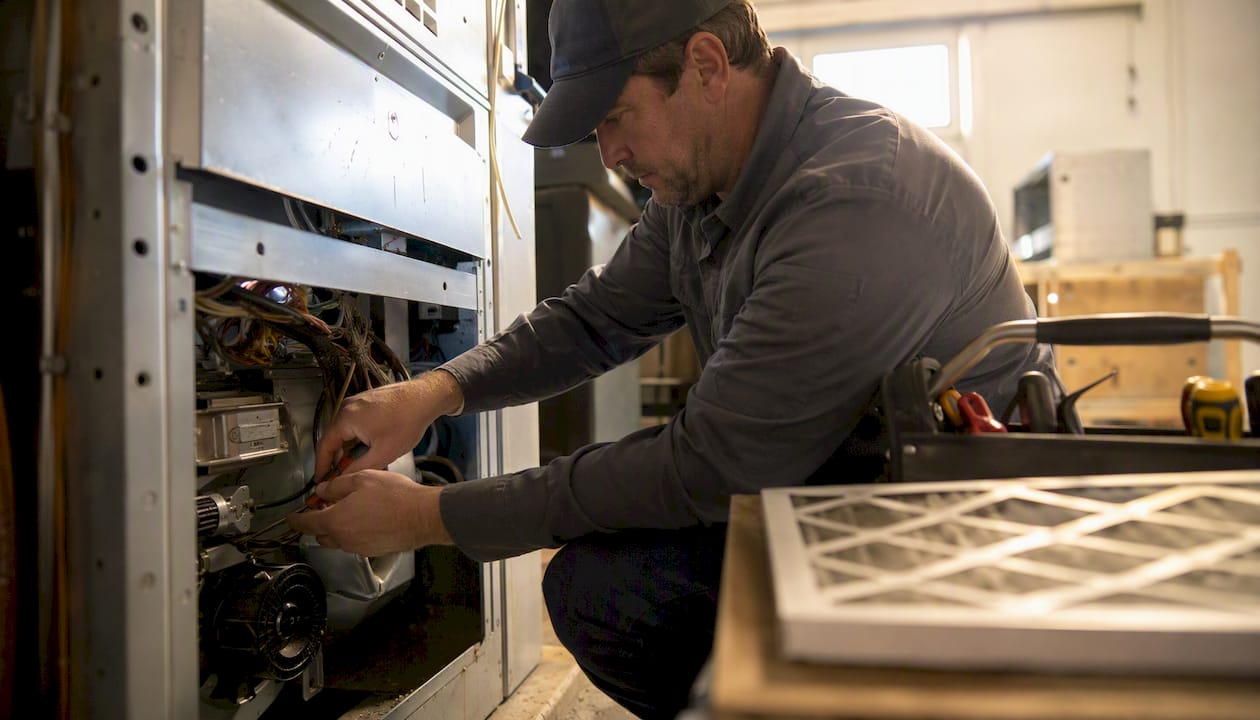
Most U.S. homeowners pay between $75 and $200 for a standard HVAC diagnostic fee during regular business hours, with after-hours and emergency calls typically running $150–$500 according to nationwide cost data. The good news: many contractors credit that fee toward your repair bill if you approve the work the same day.
Typical cost: $75–$200 for a weekday visit; $150–$500 for nights, weekends, or holidays
Credit-on-hire: Most reputable shops apply the diagnostic fee to your repair invoice when you hire them on the spot, per industry practice
Time to diagnose: A straightforward single-system check usually takes 30–60 minutes; complex or multi-system calls can run 90 minutes or longer
Key Takeaways
A standard HVAC diagnostic fee runs $75–$200 during business hours, and most reputable contractors credit that amount toward your repair when you approve the work the same day.
Point | Details |
Standard fee range | Expect $75–$200 for a weekday visit; after-hours and weekend calls run $150–$500. |
Credit-on-hire policy | Ask before booking whether the diagnostic fee applies to your repair invoice if you hire the same day. |
Diagnostic duration | Most single-system checks take 30–60 minutes; heat pump or dual-system calls run 60–90 minutes. |
Membership savings | An annual maintenance plan often reduces or waives the diagnostic fee and adds priority scheduling. |
Txcomfortcrew | Serves Greater San Antonio with a transparent credit-on-hire policy and a membership plan that lowers service fees. |
Table of Contents
What does an HVAC diagnostic fee actually cost?
The price you pay depends heavily on when you call and what you need checked. Here is how the brackets typically break down:
A weekday thermostat issue that turns out to be a faulty capacitor sits squarely in the $75–$150 range for most markets. A Saturday night no-heat call in January? Expect the higher end of the after-hours bracket, often $200 or more before any parts. Contractors use a two-bracket pricing model, with after-hours multipliers of roughly 1.5x for weeknights and 2x for weekends and holidays to cover overtime and shop overhead, as EosLog’s contractor pricing guide explains.
Regional cost of living also shifts these numbers. San Antonio and most of Texas tend to land in the lower half of national ranges, while coastal metros like San Francisco or New York often push toward the ceiling.
Pro Tip: When you call to book, ask the dispatcher: “What is the diagnostic fee, does it include the trip charge, and will it be credited toward my repair if I approve the work today?” Get a yes or no on each point before you schedule.
What a diagnostic visit actually covers
A legitimate HVAC diagnostic visit is not a technician glancing at your unit for ten minutes. Here is what a thorough scope of work looks like:
Standard diagnostic tasks:
Thermostat calibration check and wiring inspection
Electrical panel and disconnect inspection (fuses, breakers, capacitors)
Refrigerant pressure and charge verification
Combustion analysis for gas furnaces (CO, flue draft, heat exchanger visual)
Airflow and static pressure measurement
Coil and filter condition check
Controls and safety switch tracing
Blower motor amp draw test
What you should receive when the tech leaves:
A named fault or confirmed diagnosis (not just “it’s old”)
A written estimate with itemized parts and labor
A recommended repair timeline or urgency rating
Any warranty or parts-availability notes
What is not included in the diagnostic fee:
Major repairs or part replacements
Extended system teardown (e.g., pulling a compressor)
Refrigerant recovery or recharge (those carry separate material costs)
Ductwork inspection beyond accessible sections
Heat pumps add a layer of complexity. Because they run in both heating and cooling modes, a tech needs to verify reversing valve operation and defrost cycle behavior, checks that Energy.gov’s heat pump guidance outlines as distinct from standard AC diagnostics. That extra scope can push a heat pump diagnostic toward the higher end of the standard range.
How contractors structure their fees and billing terms
The phrase “service call fee” gets used loosely, and that ambiguity costs homeowners money. Here is what each term actually means:
Diagnostic fee: Covers the technician’s time to identify the problem. Includes travel, testing, and the written assessment. This is the fee most homeowners are asking about.
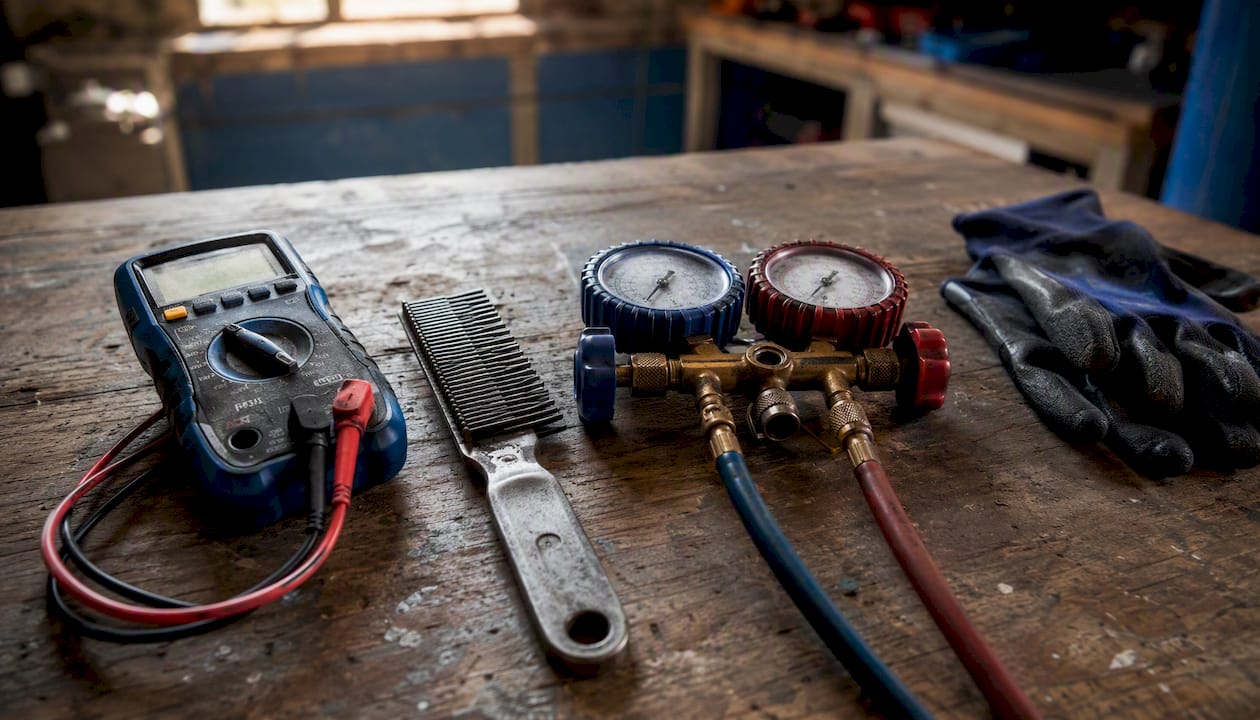
Trip fee (or service call fee): Sometimes charged separately as a flat travel cost, then the diagnostic is billed on top. Other shops bundle both into one number. Always ask which model the company uses.
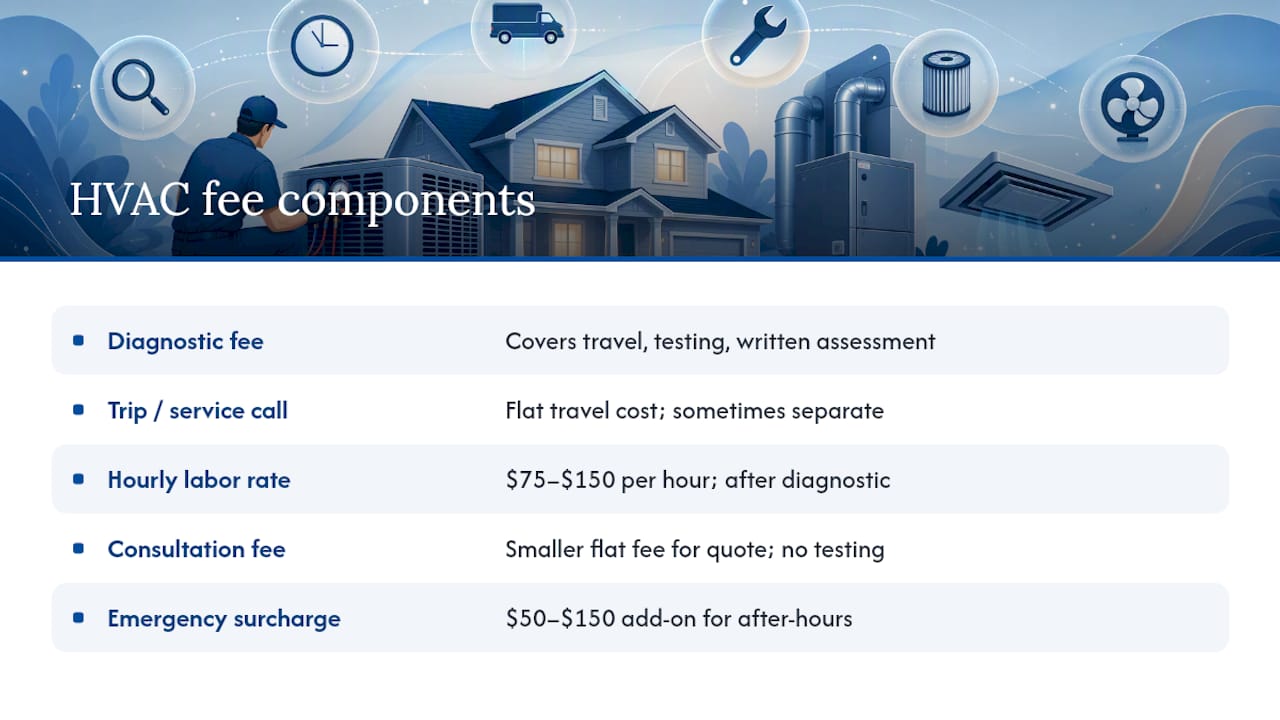
Hourly labor rate: Kicks in after the diagnostic when actual repair work begins. Rates typically run $75–$150 per hour for standard repairs, separate from the diagnostic charge.
Consultation or estimate fee: Some companies charge a smaller flat fee just to show up and give a quote, with no testing performed. This is less common but worth clarifying.
Emergency surcharge: A flat add-on (often $50–$150) layered on top of the after-hours rate for true emergency dispatch.
The most homeowner-friendly billing model is credit-on-hire: the diagnostic fee is deducted from your repair invoice when you approve the work during the same visit. Not every company does this, and some make it conditional on the repair exceeding a minimum dollar amount. Ask before you book.
Pro Tip: Use this script when you call: “Before I schedule, can you confirm the diagnostic fee, whether the trip charge is separate, and whether the fee gets credited if I approve the repair today?” A company that hesitates or gives vague answers is a yellow flag.
What drives your diagnostic fee up or down
Several factors push a quote outside the typical range, and knowing them lets you anticipate costs before the truck rolls.
Primary cost drivers:
Geography: Labor and overhead costs vary by market. Rural areas may charge a travel premium; high cost-of-living metros charge more across the board.
Time of call: After-hours multipliers are real. Contractors pay overtime under federal and state labor law, and that cost flows directly to the loaded labor rate they charge.
Number of systems: Diagnosing both an AC and a furnace in one visit costs more than a single-unit check.
Access difficulty: Attic units, crawl-space air handlers, or rooftop package units take longer to reach and inspect.
Refrigerant handling: Any diagnostic that involves checking refrigerant pressures or recovering refrigerant requires EPA Section 608 certification and specialized recovery equipment, which adds cost.
Required certifications: Gas furnace combustion analysis and certain electrical tests require licensed technicians, not just general handymen.
Quick phone checklist before you book:
Is the quoted fee all-in, or are trip and diagnostic separate?
Does after-hours pricing apply to my time slot?
Do you have EPA 608 certification for refrigerant work?
Is there a minimum repair charge before the diagnostic credit applies?
How long does an HVAC diagnostic take?
Typical durations:
Simple single-system issue (e.g., capacitor failure, tripped breaker): 30–45 minutes
Standard AC or furnace diagnostic with full testing: 45–60 minutes
Heat pump or dual-system diagnostic: 60–90 minutes
Complex fault with controls tracing or intermittent failure: 90 minutes or more
Same-visit repairs are common for straightforward faults. A failed capacitor, a clogged drain line, or a dirty flame sensor can often be fixed in the same appointment, and the credit-on-hire policy means you pay one combined bill rather than two separate charges.
When a part must be ordered, expect a return visit within one to five business days for common components. Specialty parts for older or less common systems can take longer. If the tech recommends a second opinion or a specialist (for example, a gas line issue or a refrigerant leak requiring recovery), that is a reasonable next step, not a red flag.
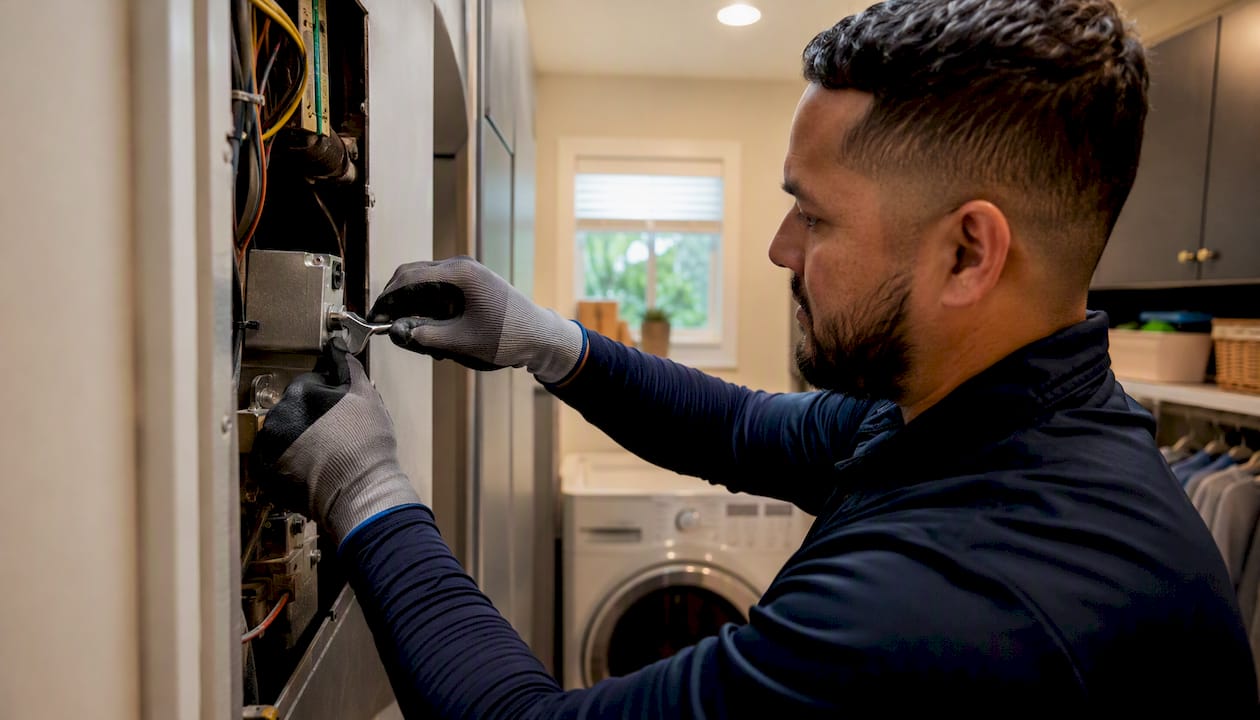
Pro Tip: If your system is failing intermittently, write down the exact symptoms, when they occur, and any error codes on the thermostat display before the tech arrives. That 10-minute prep can cut diagnostic time in half.
How to get fair value and what to ask before you book
Getting fair value from a diagnostic visit comes down to three things: asking the right questions before the truck rolls, preparing your home, and knowing when a membership saves you money.
Questions to confirm before booking:
What is the exact diagnostic fee, and does it include the trip charge?
Will the fee be credited toward my repair if I approve the work today?
What is your after-hours rate, and does my time slot qualify?
What is your hourly labor rate for repairs beyond the diagnostic?
Are your technicians EPA 608 certified for refrigerant work?
Steps to prepare your home and speed the visit:
Clear a 3-foot path around the indoor air handler and outdoor condenser
Locate your thermostat, electrical panel, and any secondary disconnect switches
Note any recent changes (new thermostat, recent filter replacement, unusual sounds or smells)
Have your system’s model and serial number ready (usually on a label inside the air handler door)
Membership plans are where the math gets interesting. Many HVAC companies offer annual maintenance memberships that reduce or waive the diagnostic fee entirely for covered visits, include one or two preventative tune-ups per year, and bump you to priority scheduling. Txcomfortcrew’s membership plan is built exactly on this model: members in the Greater San Antonio area get reduced service fees, priority dispatch, and preventative inspections that catch problems before they become emergency calls.
Pro Tip: If your system is running but struggling, a weekday appointment almost always costs less than waiting until it fails on a Friday night. The after-hours premium alone often exceeds a full year of membership dues.
How this guide’s ranges were determined
The price bands in this guide come from a combination of publicly available labor data, federal agency guidance, and contractor-side pricing methodology, not from a single source or a single market.
Primary data inputs:
BLS Occupational Outlook Handbook for median HVAC technician wages and loaded labor cost estimates
EPA Section 608 regulations for refrigerant-handling cost drivers
EosLog’s contractor pricing methodology for after-hours multipliers and shop-economics math
ServiceTitan’s industry guide for credit-on-hire prevalence and billing model definitions
HVAC Calculator Hub’s 2026 cost guide for nationwide fee band aggregation
The methodology: BLS median wages were used to anchor loaded labor costs (wages plus benefits, truck, insurance, and overhead). Those figures were cross-referenced against published contractor pricing guides and nationwide cost aggregators to produce ranges that reflect real market conditions rather than a single company’s pricing.
Why diagnostic fees are worth paying, when done right
There is a version of this conversation that goes sideways fast: a homeowner refuses to pay a diagnostic fee, the tech gives a surface-level look, and the “repair” misses the actual fault. Two weeks later, the system fails again.
A diagnostic fee is not a cover charge. It pays for a trained technician’s time, their truck, their tools, their certifications, and the liability they carry when they put their name on a diagnosis. The BLS data on HVAC technician wages makes clear this is skilled trade work, not a commodity. When you pay a fair fee and get a thorough diagnosis, you are buying certainty, not just a service call.
What I would push back on is the idea that the fee itself signals quality. A $200 diagnostic from a company with no reviews and no licensing verification is a worse deal than a $125 fee from a licensed, insured contractor with a clear credit-on-hire policy. The fee is table stakes. The technician’s credentials and the company’s transparency are what actually protect you.
Txcomfortcrew makes diagnostics straightforward for San Antonio homeowners
Paying a fair HVAC service charge is one thing. Knowing exactly what you are getting, and having the fee count toward your repair, is another. Txcomfortcrew handles diagnostics with a clear credit-on-hire policy: when you approve the repair during the same visit, the diagnostic fee comes off your total. No fine print, no minimum repair threshold.

Members get an even better deal. The Txcomfortcrew membership plan covers the Greater San Antonio area and includes reduced service fees, priority scheduling, and preventative inspections that catch problems before they turn into emergency calls. If you are in Spring Branch, Helotes, or anywhere across the Txcomfortcrew service area, check your coverage and book a diagnostic visit today.
Sources
These are the primary references used to build this guide, each useful for a different question:
Recommended
Comments