
Stop AC Burning Smells: Texas Safety Guide, 15–30‑Minute Dust Rule
If your AC smells like a faint, dusty warmth right when it kicks on for the season, give it 15 to 30 minutes to clear before you worry. If you smell anything sharp, plastic, rubbery, like gunpowder, or sickly sweet, that’s not startup dust. Turn the thermostat off, flip the breaker, and call a licensed HVAC technician before you do anything else.
TL;DR:
Burning electrical smells or smoke indicate immediate fire risk and require shutting off the system, ventilating the area, and calling a licensed technician or emergency services.
Most burning odors result from dust burn-off, dirty filters, or overheating components, which are usually minor and resolve within 30 minutes without intervention.
Foul plastic, chemical, or gunpowder scents point to electrical faults or arcing, demanding urgent inspection and repair by professionals.
Refrigerant leaks produce sweet, chemical odors and call for ventilation and professional handling due to health risks, but are less immediately fire-related.
Routine maintenance, including filter replacement and annual professional checkups, can prevent the recurrence of burning smells and improve system safety.
Table of Contents
Is a Burning Smell From an AC an Emergency?
Some burning smells can wait a few minutes. Others cannot wait at all. The difference comes down to what you smell, how strong it’s getting, and what else is happening in the house.
Treat it as an emergency if you notice any of the following:
Visible smoke or haze near the vents, thermostat, or outdoor unit.
A sharp, acrid, or plastic odor rather than a dusty one.
The breaker tripping once, or tripping repeatedly when reset.
Sparks, popping sounds, or a burning smell that’s getting stronger, not weaker.
Any burning odor that hangs around longer than 30 minutes.
Electrical faults cause fires because damaged wire insulation melts under heat, and a loose or corroded connection can arc, essentially a tiny lightning strike inside your wall or unit. Repeatedly resetting a tripping breaker instead of getting it inspected is a known risk factor for electrical fires, according to safety-industry guidance, not a harmless annoyance to shrug off.
Your emergency checklist is short: thermostat off, breaker off, open a window or two, and call a professional (or 911 if you see actual flames or thick smoke). Don’t try to restart the system to “see if it clears.” Industry guidance is blunt about this: shut the system down at both the thermostat and the breaker if you smell electrical burning or see smoke, and leave it off until someone qualified inspects it, according to Discount ACR.
What Usually Causes a Burning Smell From an AC?
Most burning odors trace back to one of seven culprits, and they range from “no big deal” to “call someone today.”
Dust burn-off. Dust settles on heating elements or coils over the off season and burns away the first time the system runs. It’s harmless and usually gone within half an hour.
A clogged air filter. Restricted airflow forces the blower motor to work harder than it should, and that extra strain generates heat. Hvac notes that a dirty filter is one of the most common, and most fixable, causes of a burning smell if you catch it early.
An overheating blower motor. Worn bearings or motor windings stressed by restricted airflow can produce a hot, electrical odor. Replacing a clogged filter before permanent damage sets in can sometimes reverse the overheating, but once the windings themselves are damaged, only a technician can replace the motor safely.
A failing capacitor. Capacitors that fail often vent electrolyte, producing a fishy or chemical smell near the outdoor unit. Capacitors hold an electrical charge even when the power is off, so this is strictly a job for a trained technician, according to Discount ACR.
Electrical wiring or shorts. Frayed insulation or a loose connection smells like burning plastic or, in some cases, gunpowder from arcing contacts.
A worn or slipping belt. Older systems with belt-driven blowers can produce a distinct burning rubber smell paired with weaker airflow.
Refrigerant leaks. These smell sweet or chemical, closer to chloroform than anything electrical, and they’re a health concern rather than a fire risk.
Pro Tip: If the smell is strongest right at a vent versus right at the outdoor unit, you’ve already narrowed the list. Indoor odors point to the filter, blower, or wiring; outdoor odors point to the capacitor or compressor.
What Does the Smell Actually Tell You?
The character of the smell is your fastest diagnostic tool, and it’s more reliable than guessing based on the system’s age alone.
Electrical-burning and refrigerant odors are two entirely different hazards that call for two different responses. Electrical smells mean immediate fire risk. Refrigerant smells mean a health and efficiency issue that still needs a technician, but not the same panic level, according to Hvac.
Smell profile | Likely cause | Urgency |
Dusty, mild, fades in 15 to 30 minutes | Startup dust burn-off | Low, monitor |
Sharp plastic or chemical | Wiring fault or failing capacitor | High, shut off now |
Burning rubber | Worn or slipping belt | Medium, schedule soon |
Gunpowder or metallic | Electrical arcing | High, shut off now |
Sweet, sickly, chloroform-like | Refrigerant leak | High, ventilate and call a pro |
Watch for confirming symptoms alongside the smell: a breaker that trips, airflow that drops off, vents blowing warm instead of cool, or a new humming or buzzing sound from the unit. Any of those alongside a non-dusty smell means stop guessing and call someone.
What to Do the Moment You Smell Burning
Work through these steps in order, and don’t skip ahead.
Set the thermostat to Off. This stops the system from calling for more cooling while you assess the situation.
Cut power at the breaker. Find the dedicated AC breaker in your panel and switch it off. If your outdoor unit has a nearby disconnect or isolator switch, turn that off too.
Ventilate and hold off on repairs. Open windows, avoid restarting the system, and never open a capacitor or touch internal wiring yourself. Refrigerant exposure can pose health risks, so ventilating the space matters even before a technician arrives, according to WebMD. If you see flames or heavy smoke, get everyone out of the house and call 911 first.
Following this sequence protects both your system and your home. HVAC guidance consistently frames a noticeable burning smell as a late-stage warning sign, meaning by the time you smell it, a component may already be dangerously hot, according to Bryant.
When Do You Need a Licensed Technician or Electrician?
Call immediately if you’re dealing with any electrical smell, a persistent acrid odor, visible smoke, a breaker that keeps tripping, or visible scorch marks or melted wiring near the unit. These aren’t do-it-yourself repairs, and attempting them yourself risks both injury and further damage.
A technician arriving for a burning smell call typically follows a sequence of inspection steps:
Visual inspection of the indoor coil, blower compartment, and outdoor unit for scorching or damage.
Electrical testing on wiring, connections, and the capacitor to check for shorts or degraded components.
Capacitor or motor replacement if either has failed.
Refrigerant leak detection if the smell points to a chemical or sweet odor rather than an electrical one.
Expect a diagnostic visit, a written estimate before any work starts, and a repair timeline that depends on parts availability. Costs generally vary based on the specific repairs needed, including diagnostic fees and parts replacement. You can get a clearer sense of typical diagnostic fee ranges before your appointment, and if reduced airflow was part of the problem, it’s worth reviewing quick cooling checks as well.
How Do You Prevent Burning Smells From Coming Back?
Most burning-smell calls trace back to neglected basics, and they’re genuinely preventable with a routine.
Replace filters on schedule. ENERGY STAR maintenance guidance recommends checking filters monthly and swapping them as needed, since a clogged filter is one of the most common triggers for an overheating blower motor.
Book annual professional maintenance. A technician tightens electrical connections, lubricates motor bearings, inspects the capacitor, and cleans the coils, catching small problems before they turn into burning-smell calls.
Run a seasonal startup check. Clear leaves and debris from around the outdoor unit, glance for any rodent damage to wiring, and note anything that looks frayed or chewed before you flip the system on for the season.
Pro Tip: Mark your filter’s replacement date on the filter itself with a marker. It takes ten seconds and ends the guessing game every single month. A structured maintenance plan folds all of this into one scheduled visit instead of leaving it to memory. For a sense of how appliance smells signal underlying problems more broadly, the same troubleshooting logic shows up in air fryer burning smell diagnostics, where a burnt odor almost always points to a specific, fixable cause rather than random malfunction.
How Texas Comfort Crew Triages a Burning-Smell Call
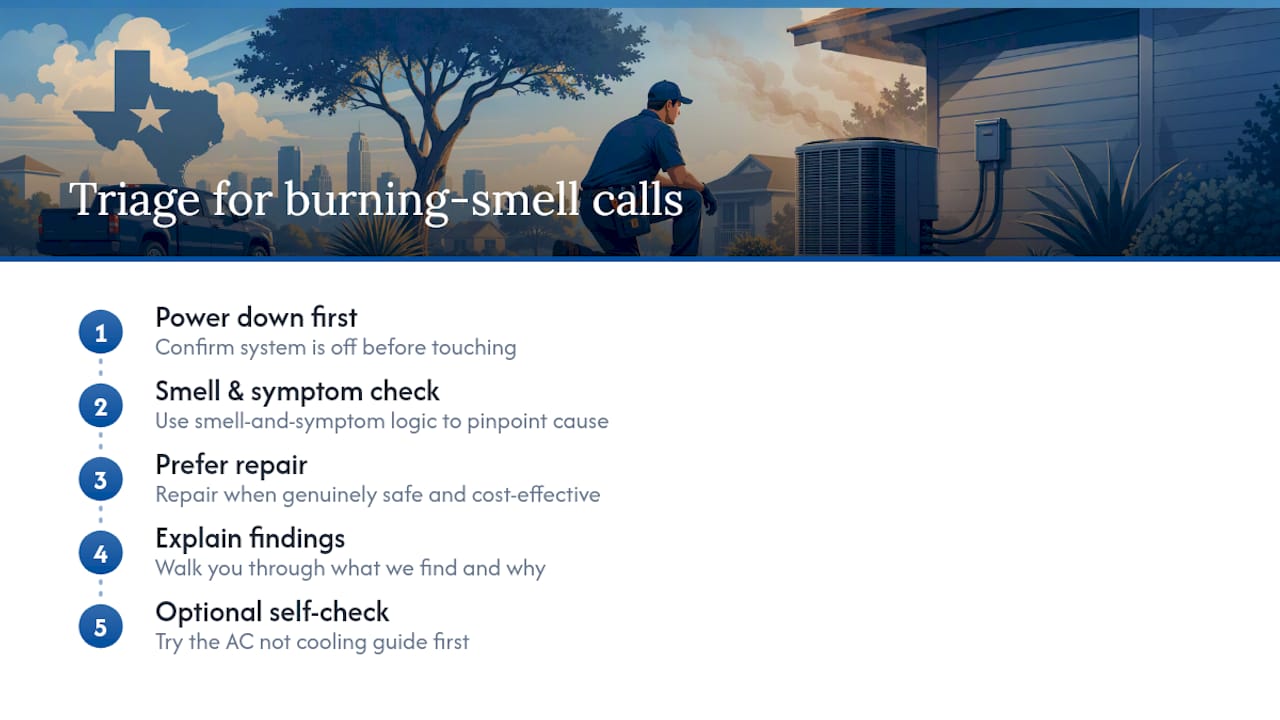
Every burning-smell call starts with safety, not sales. Our technicians confirm the system is powered down before they touch anything, then walk through the same smell-and-symptom logic covered above to pinpoint the cause fast.
We lean toward repair over replacement whenever the fix is genuinely safe and cost-effective, and we walk you through exactly what we find and why, so you’re deciding with full information, not pressure. If you want to troubleshoot a related cooling issue on your own first, our AC not cooling guide is a good starting point before you call.
Get Emergency AC Help From Texas Comfort Crew
A burning smell is not the moment to shop around for hours or wait on a callback. Texas Comfort Crew answers emergency HVAC calls with the goal of diagnosing the real problem fast, whether that’s a $15 filter or a failed capacitor, and fixing what’s actually broken instead of pushing you toward a full system replacement you don’t need.

When you call, have three details ready: what the smell actually smells like (dusty, plastic, rubber, sweet), whether your breaker has tripped, and roughly how old your system is. That alone cuts diagnostic time significantly once a technician arrives. Our team handles emergency diagnostics, capacitor and motor replacement, and ongoing maintenance plans built to catch these problems before they turn into a burning-smell call in the first place. If your burning smell turns out to be part of a bigger system failure, our AC replacement guide covers what that decision actually looks like. Reach out through Texas Comfort Crew to schedule emergency service or check availability in your area today.
Sources
FAQ
Is It Safe to Stay in a House With a Burning Smell?
If the smell is faint dust burn-off that clears within 30 minutes, staying is fine. If it’s sharp, plastic, or getting stronger, leave the affected area, cut power at the breaker, and call a technician immediately, or 911 if you see smoke or flames.
Why Does the Air Smell Burnt When the AC Runs?
Most often it’s dust burning off startup elements, a clogged filter straining the blower motor, or a failing capacitor near the outdoor unit. Sharp plastic or gunpowder smells usually point to electrical wiring or arcing, according to HVAC.com.
Is a Bad AC Smell Harmful to Your Health?
Refrigerant leaks can pose real health risks if you’re exposed in a closed space, which is why ventilation matters even before a technician arrives, according to WebMD. Electrical burning smells aren’t typically a health hazard to breathe briefly, but they signal fire risk, which is the bigger danger.
What Does Burning AC Refrigerant Smell Like?
Refrigerant odors tend to be sweet or chemical, similar to chloroform, rather than sharp or plastic-like. If you notice this smell, ventilate the area and call a licensed technician, since handling refrigerant safely requires specialized equipment and training.
What Does Texas Comfort Crew Charge to Diagnose a Burning Smell?
Pricing for diagnostic visits and repairs is available directly through Texas Comfort Crew, since costs vary depending on the specific cause found during inspection.
Recommended
Comments